Start
Run it after a literature turn in the same session, so it has evidence to work from:
text
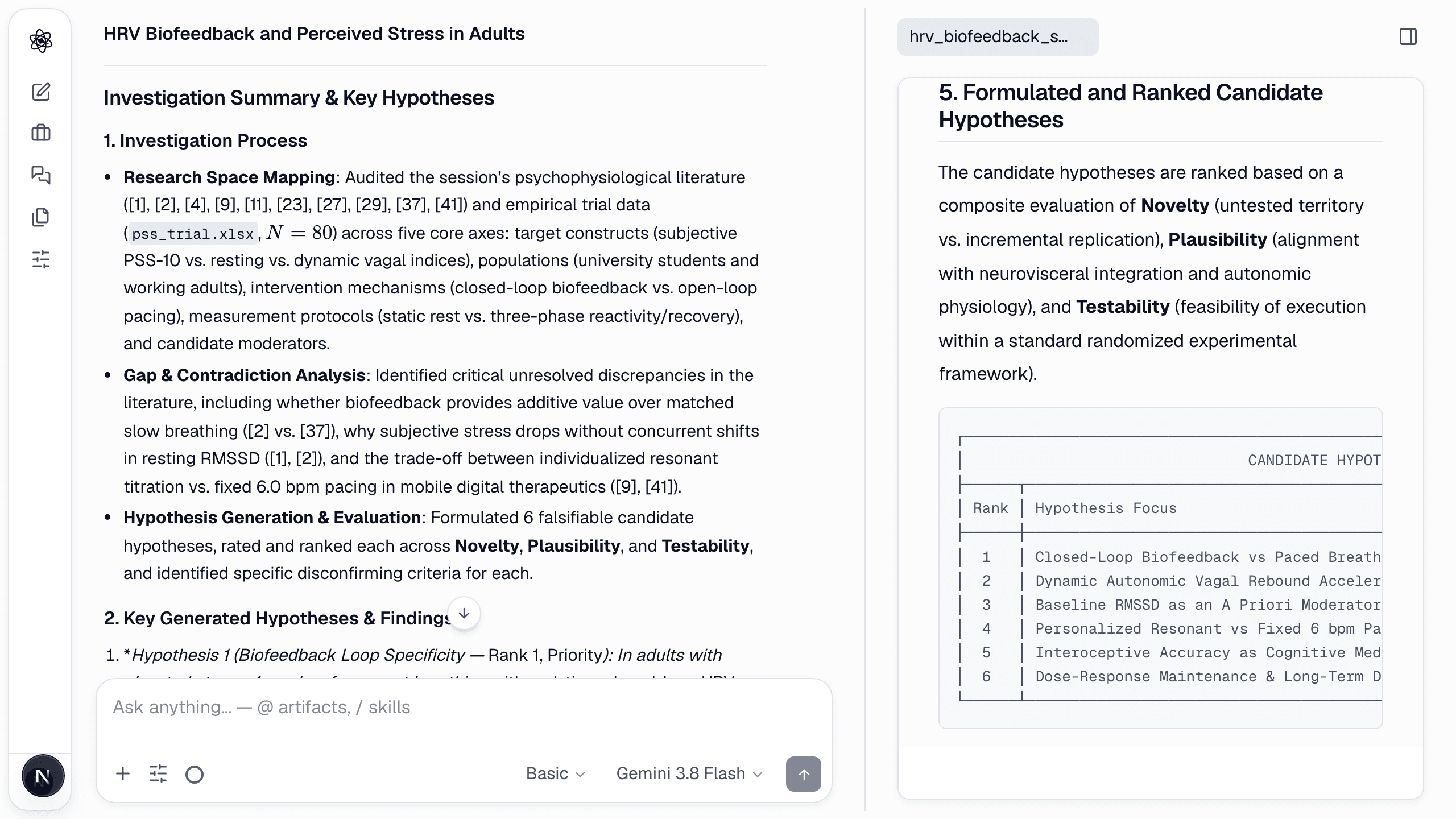
/hypothesis Based on the HRV biofeedback literature collected in this session, map the research space, list gaps and contradictions, and generate testable hypotheses ranked by novelty, plausibility and testability.
You can also run it on its own — it will search first.
What you get
<topic>_hypotheses.md — a design-level proposal (typically 2,500–4,000 words, 20+ citations) with:
- Prior work survey — a table of what earlier studies did: design, sample, manipulation, measure, result with effect size, limitation, each cited
[n]. - Research-space map — the constructs, populations, manipulations, measures and moderators the literature covers, what is thin and what is absent, plus a diagram inline.
- Established / contested / untested — what is settled, where results disagree (both sides cited) and what nobody has tested.
- Candidate hypotheses (4–8) — each a full section: type and gap addressed, rationale (mechanism + prior evidence), a novelty check against the closest existing study, the expected result and effect size, a study-design sketch (design type, IV and levels, DV and instrument, population, sample size from a power assumption, primary analysis, controls), the result that would disconfirm it, feasibility, and scores for novelty, plausibility, testability and impact.
- Ranking and a recommended first study written so the experiment-design skill can take it as input.
The skill checks its own document (hypothesis_check) for these parts before finishing.
Next step
Pick one and ask for the design: "Design an experiment to test hypothesis 2" — the experiment-design skill reads the hypothesis and its sources.
Walkthrough: From literature to hypotheses.