Neutropic is also an MCP server. Any AI app that speaks the Model Context Protocol — Claude (web, desktop and mobile), ChatGPT, Claude Code, Cursor and others — can use Neutropic as a set of tools: real literature search, citation checks, statistics with assumption checks, power analysis, and the full research skills (literature review, manuscript writing, peer review, hypothesis design, EEG and data analysis). Everything the app runs is saved to your Neutropic account, so you can open the results in the web app and keep working.
Using Neutropic from AI apps needs a paid plan. You can connect on any plan, but the app's requests are declined until you upgrade. Tasks use your managed tokens exactly like a chat in Neutropic.
Before you start: Settings → MCP
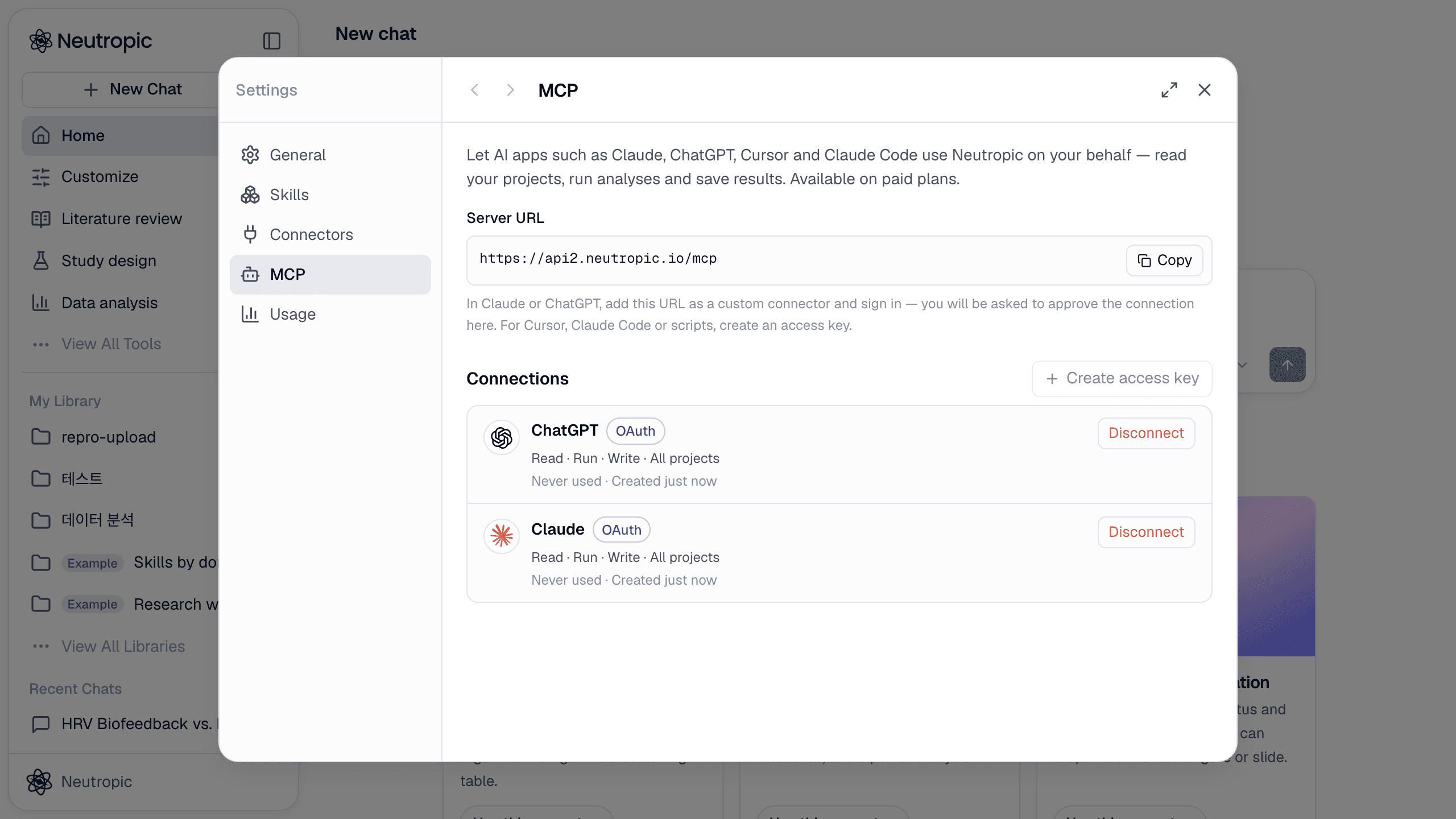
In Neutropic's sidebar, open Customize → MCP (the app also calls this Settings → MCP). You'll find the server URL to paste into your AI app, and the list of apps and access keys connected to your account.
https://api2.neutropic.io/mcp
There are two ways to connect:
- Sign in (OAuth) — for Claude and ChatGPT. You add the URL in the app, sign in to Neutropic, and approve. No key to copy.
- Access key — for Claude Code, Cursor and your own scripts. You create a key in Neutropic and put it in the tool's configuration. (Claude Code can also sign in with OAuth.)
Claude (claude.ai, Claude Desktop, mobile)
- In Claude, open Settings → Connectors and choose Add custom connector.
- Enter a name (Neutropic) and the server URL
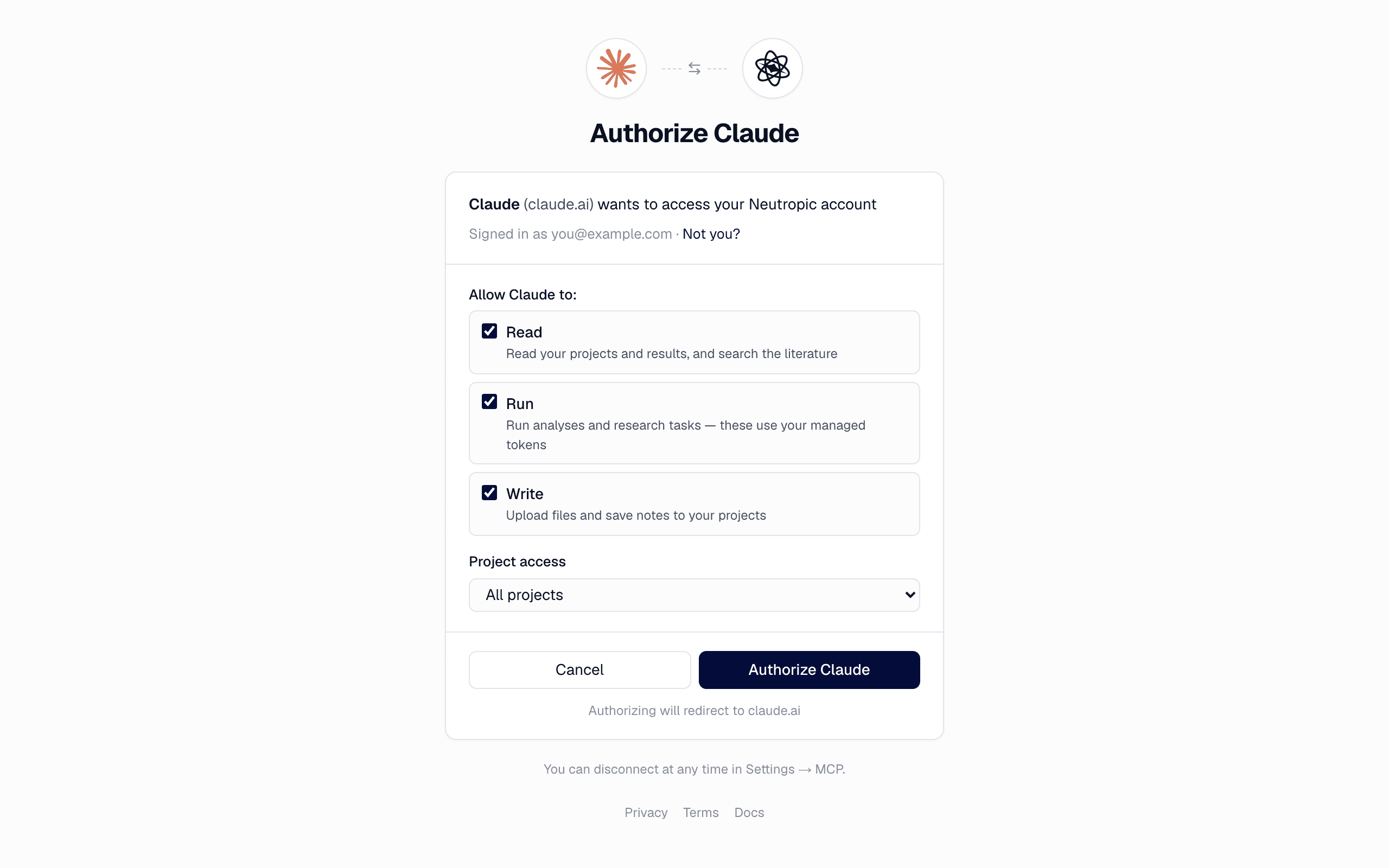
https://api2.neutropic.io/mcp, then Add. - Click Connect. A Neutropic window opens — sign in if asked, check the permissions and click Authorize Claude.
- In a chat, make sure Neutropic is turned on in the tools menu (the + / search-and-tools button under the message box), then just ask: "Use Neutropic to find RCTs on HRV biofeedback for anxiety since 2020."
A connector added on claude.ai is also available in Claude Desktop and the Claude mobile apps signed in to the same account. On Claude Team and Enterprise, an organization Owner may need to add the connector first.
ChatGPT
- In ChatGPT, open Settings → Apps & Connectors → Advanced settings and turn on Developer mode (available on plans that support custom connectors).
- Back in Apps & Connectors, choose Create. Name it Neutropic, paste
https://api2.neutropic.io/mcpas the MCP server URL, pick OAuth for authentication, confirm you trust the app, and Create. - ChatGPT sends you to the same Neutropic consent screen — review the permissions and click Authorize ChatGPT.
- In a new chat, open + → More → Developer mode, select Neutropic, and ask your question.
ChatGPT renames these menus from time to time; if you can't find them, search its help for "custom connectors" or "developer mode".
Claude Code
Sign in with OAuth — no key needed:
claude mcp add --transport http neutropic https://api2.neutropic.io/mcp
Then run /mcp inside Claude Code, pick neutropic and choose Authenticate; approve in the browser window that opens.
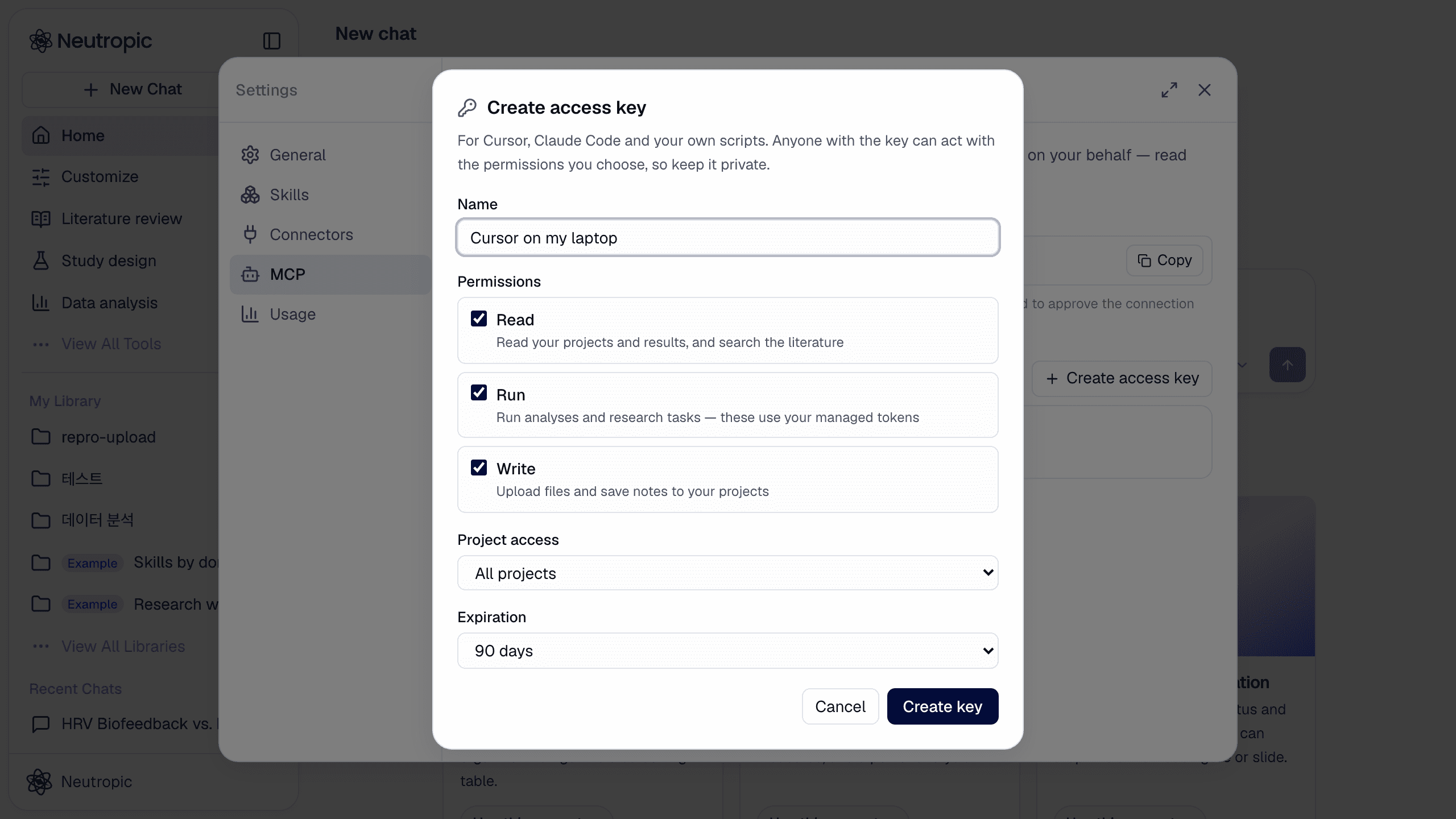
Or use an access key (useful on servers and in CI). In Settings → MCP, click Create access key, give it a name, choose permissions, project and expiry, then Create key.
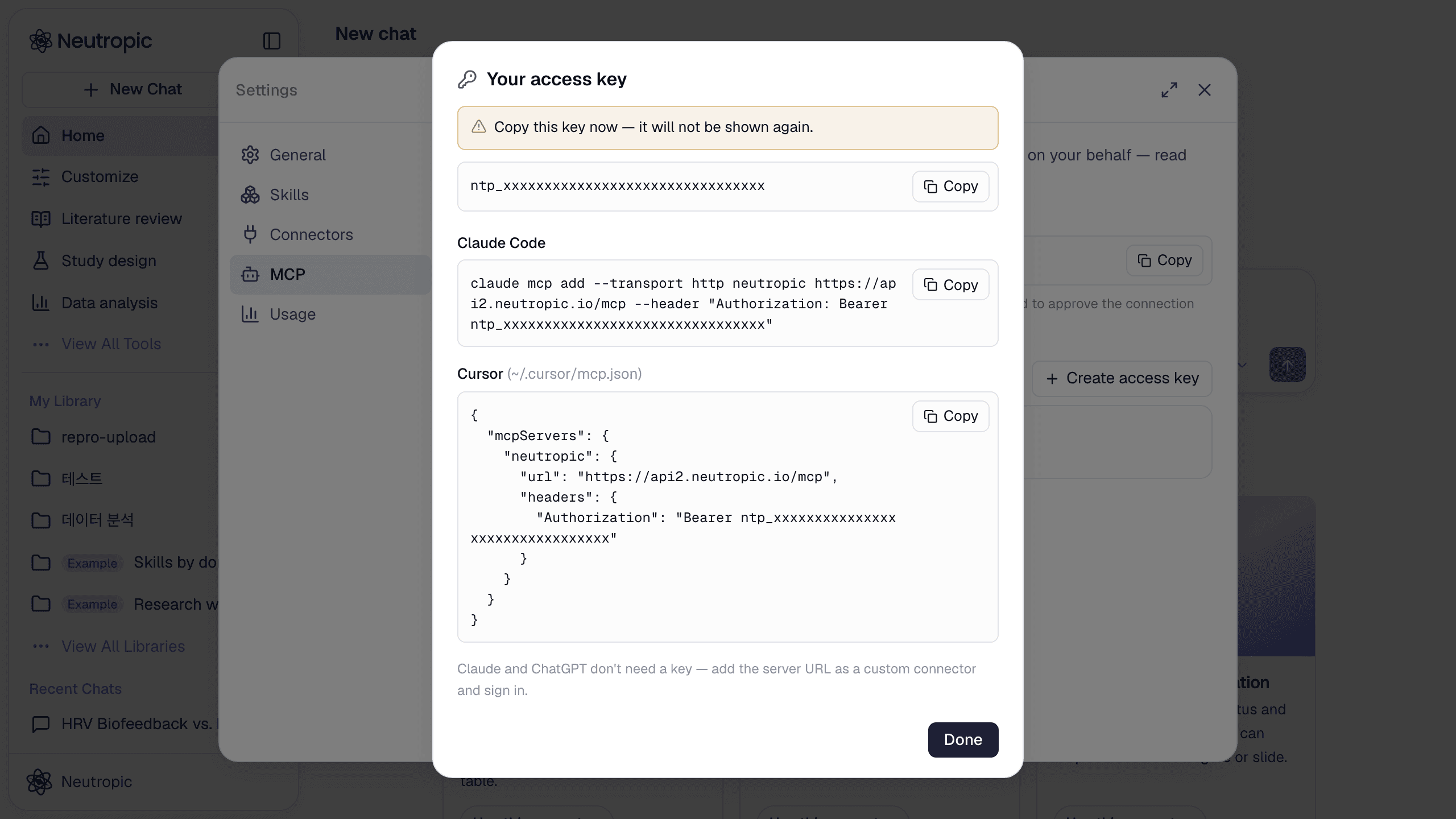
The key is shown once, together with ready-to-paste setup for Claude Code and Cursor:
claude mcp add --transport http neutropic https://api2.neutropic.io/mcp \
  --header "Authorization: Bearer ntp_…"
Cursor
Create an access key as above and add Neutropic to ~/.cursor/mcp.json (or .cursor/mcp.json in a project):
{
  "mcpServers": {
    "neutropic": {
      "url": "https://api2.neutropic.io/mcp",
      "headers": { "Authorization": "Bearer ntp_…" }
    }
  }
}
Restart Cursor or reload its MCP settings; neutropic should list its tools.
Other apps and scripts
Any MCP client with Streamable HTTP transport works: point it at https://api2.neutropic.io/mcp and either let it sign in with OAuth (Neutropic supports dynamic client registration) or send Authorization: Bearer <access key>.
Permissions
You choose them on the consent screen or when you create a key, and you can narrow a connection to a single project.
| Permission | Lets the app |
|---|---|
| Read | Read your projects and results, and search the literature |
| Run | Run analyses and research tasks — these use your managed tokens |
| Write | Upload files and save notes to your projects |
What the app can do
| Tool | Does |
|---|---|
search_literature | Search PubMed and Crossref — real records with DOIs |
verify_citations | Check that DOIs or reference titles exist and match (up to 10 at a time) |
run_stat_test | Compare groups with the test chosen from the design and assumption checks; effect sizes, CIs and an APA sentence |
power_analysis | Sample size or power from an effect size |
run_skill · get_task · continue_task · cancel_task | Start a research skill in the background (literature review, manuscript, peer review, hypothesis, data or EEG analysis …), follow it, send a follow-up or stop it |
list_skills | The skills run_skill can use |
list_projects · list_artifacts · get_artifact | Browse your projects and read reports, manuscripts and tables |
upload_file · save_note | Send a data file for analysis; save a note to a project's memory |
Clients that support MCP prompts also get shortcuts for literature review, statistics, peer review, hypothesis design and reference checks.
Things to try:
- "Check whether every reference in this bibliography really exists." →
verify_citations - "Here's my CSV — did reaction time differ between the two conditions?" →
run_stat_test - "How many participants for d = 0.4 at 80% power?" →
power_analysis - "Run a deep literature review on neurofeedback for ADHD with Neutropic." →
run_skill, thenget_taskuntil it's done. Long tasks take several minutes; the app checks back for you.
Where results go
- Research tasks started by an app appear in your Neutropic Recent Chats with a via Claude / via ChatGPT badge — open them to read the full report, see the sources and keep going in Neutropic.
- Quick tools (statistics, power, uploads) collect in one chat per connection, named after the app.
- Every answer includes a link back to Neutropic.
Disconnect
In Settings → MCP, click Disconnect next to an app or access key. Access stops immediately; the app has to connect again (or you create a new key). Removing the connector inside Claude or ChatGPT may not revoke Neutropic's side, so disconnect here too.
Trouble? The app shows Neutropic's message: paid plans means the account needs an upgrade; expired or unauthorized means reconnect or create a new key. See also Connector authorization.