Neutropic 2.0

Your research agent for human sciences

From literature and experiment design to multimodal data analysis and scientific discovery — built for neuroscience, psychology, behavioral science, and HCI.

Introducing Neutropic

Today’s AI tools aren’t built for research. They summarize papers but can’t run the analysis. They lose the trail from results back to evidence, and they stop the moment the statistics get real.

Neutropic is a research agent built for human sciences. It works across your literature, data, and analyses, and handles complex work other tools can’t: psychometrics, multimodal biosignals, statistical review, and everything in between.

Built for scientific research

One research agent across the whole workflow — from the first literature search to the submitted manuscript.

01 · Literature review

Review the field with every claim cited

Ask a question and the agent fans out across PubMed, Crossref, OpenAlex, Semantic Scholar — plus Scopus, Web of Science, and KCI when connected — and composes a report where every sentence carries an [n] citation.

Papers, patents, and the web in one run; each claim links to a real, checked source, and uncited claims are removed rather than published.
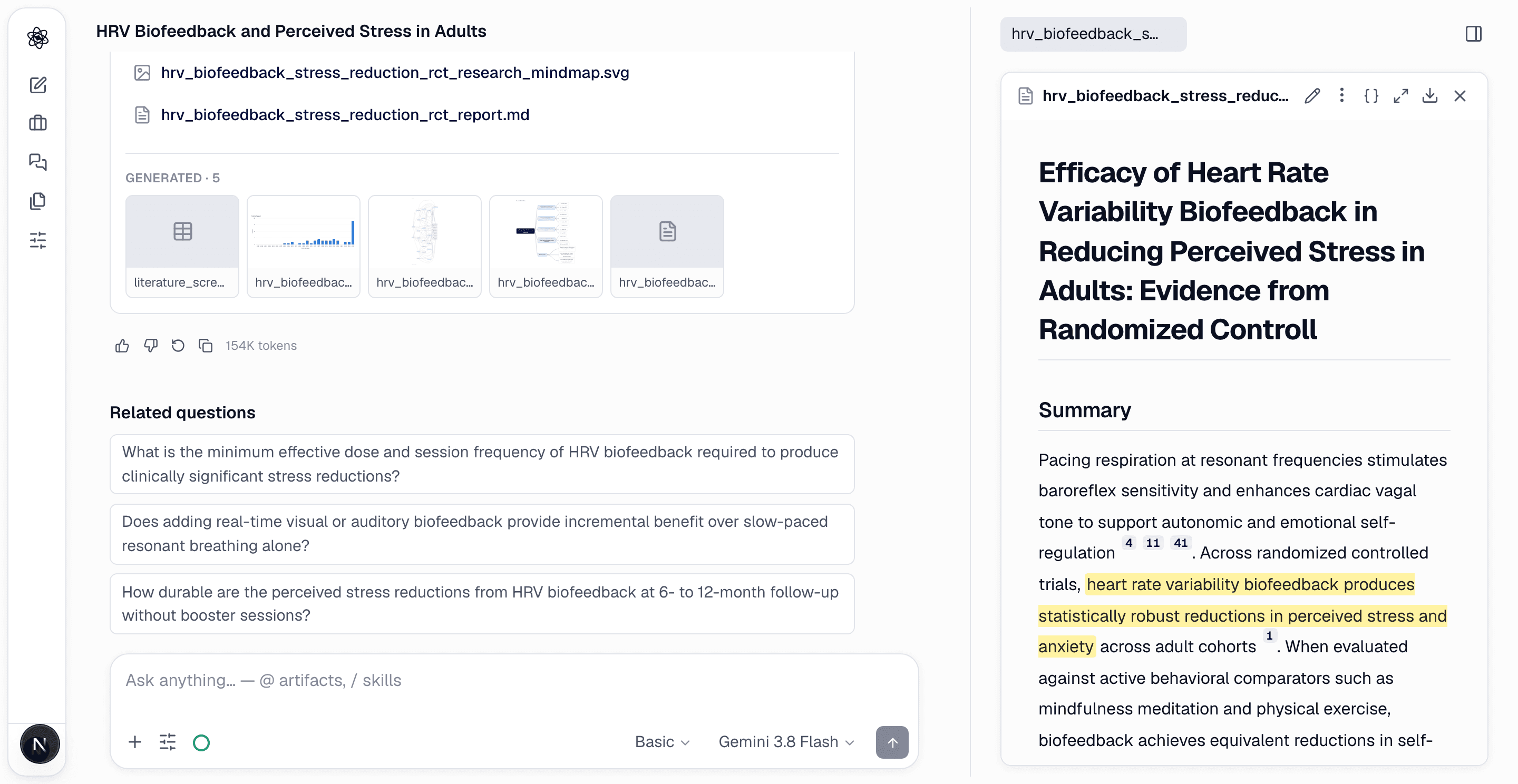
Literature review report with numbered citations and the source panel open
02 · Research design

From hypotheses to a study you can defend

Turn gaps and contradictions into ranked, testable hypotheses, then into a full design — participants, measures, protocol flow, and a power curve — with the reference study behind every choice.

Each candidate carries a source-backed rationale and the rival explanations it must rule out.
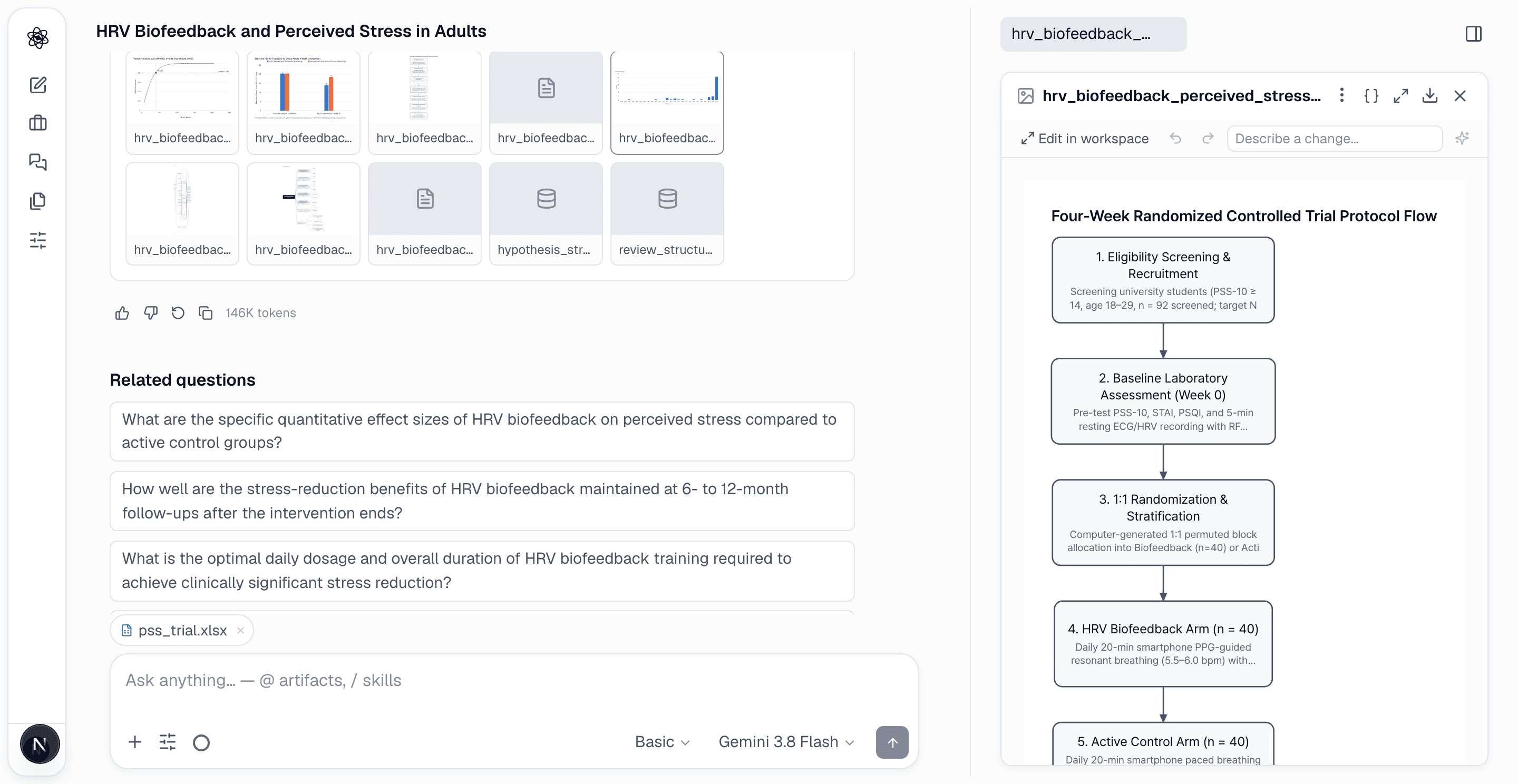
Study design report with a protocol flow diagram and a power curve
03 · Data analysis

From raw signals to analysis-ready data

Load survey exports, logs, recordings, or biosignals once and work by reference. Inspection, cleaning, and exploratory checks are recorded step by step — nothing is dropped silently.

Data quality report, explicit analysis plan, and a cleaning log you can hand to a reviewer.
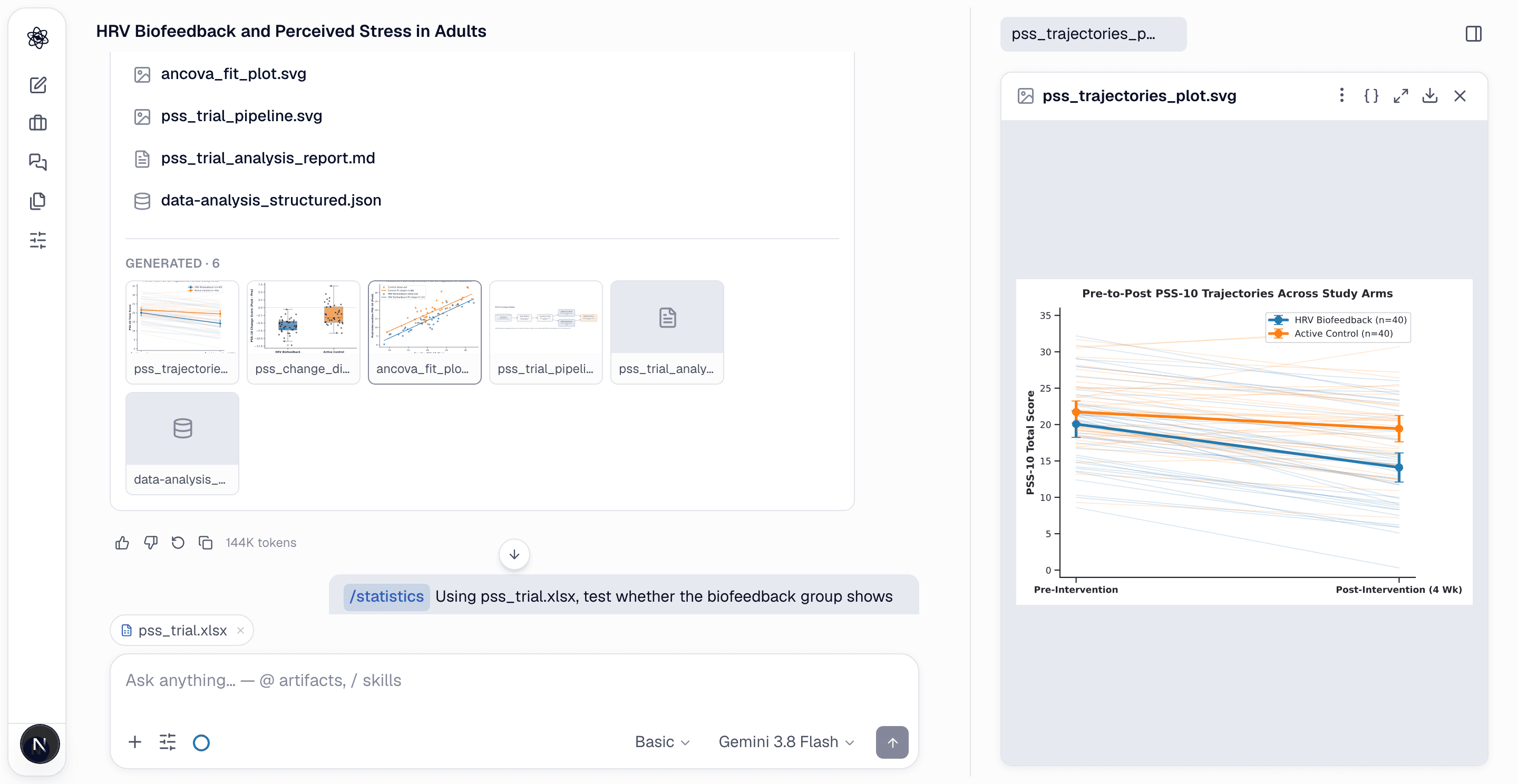
Data analysis report with a data-quality summary and multimodal signal timelines
04 · Statistical analysis

Modern models with assumptions checked twice

Identify the design, audit assumptions, choose and justify the test, run diagnostics, and report effects with uncertainty — from t-tests to SEM, IRT, mixed-effects, and Bayesian models.

Variables, distributions, repeated measures, and study structure drive the recommendation, with the reasoning shown.
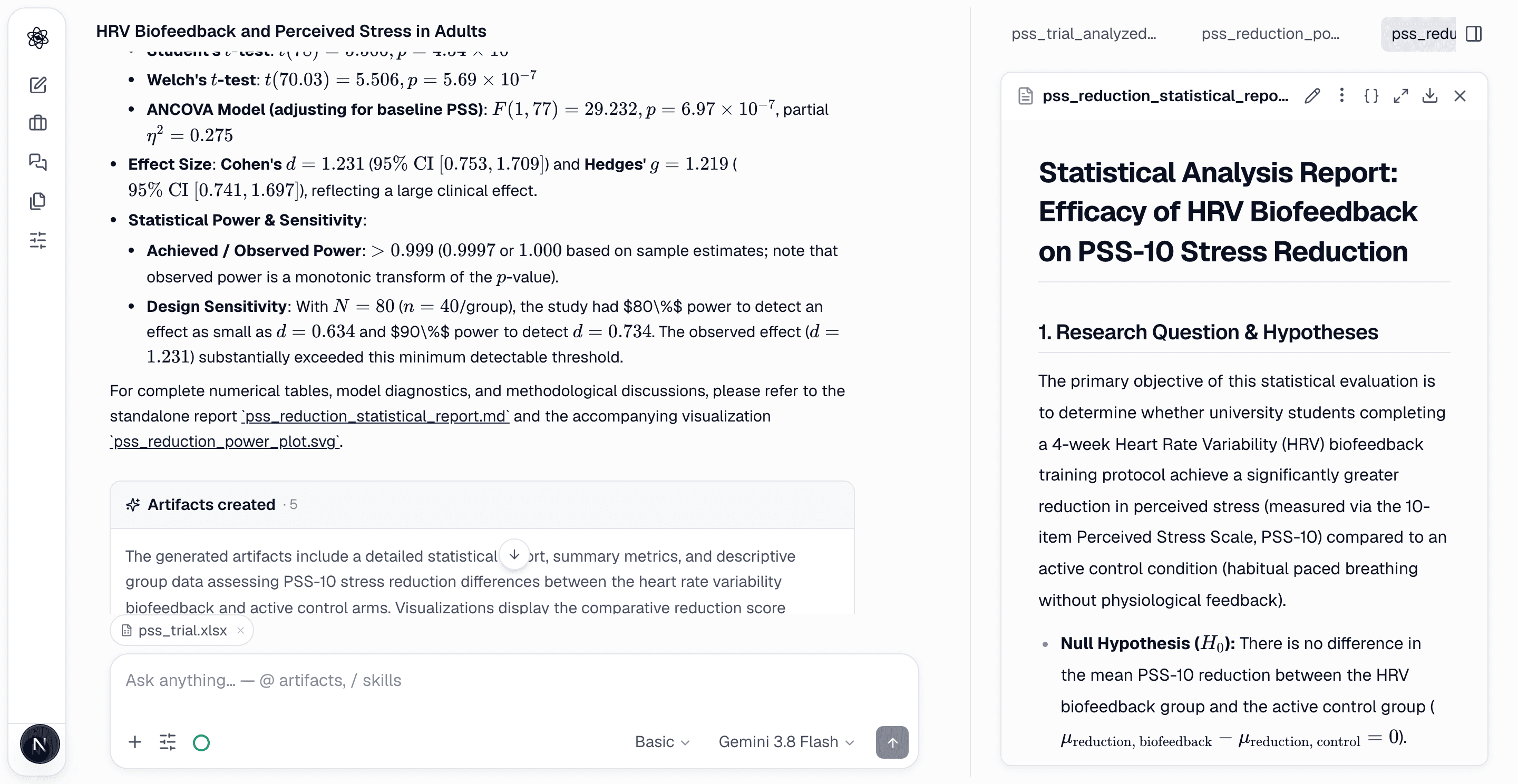
Statistical report with effect sizes and confidence intervals, and a review-agent check
05 · Figures

Publication-ready figures you can still edit

Draw study flows, conceptual frameworks, SEM/path models, analysis pipelines, and charts as editable vector figures, with journal templates and multi-panel composition.

Nodes, arrows, and panels stay editable in the workspace; export to SVG, PNG, PDF, or PPTX.
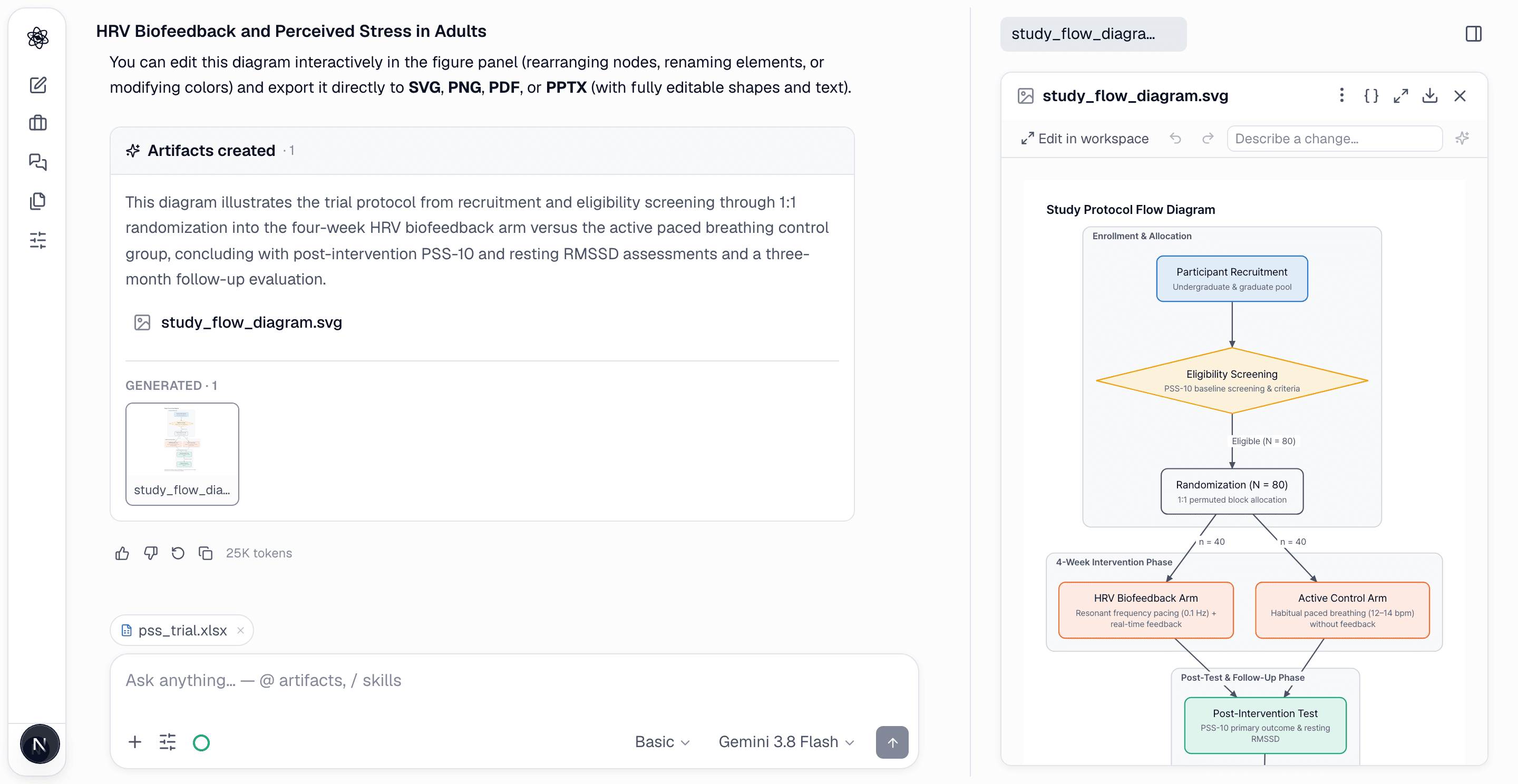
Vector figure editor showing an editable path diagram with the export menu
06 · Paper writing

Manuscripts that never drift from the data

Turn the project's sources, analyses, and figures into IMRaD sections where every claim is bound to a citation or to a session result — and anything unsupported is disclosed, not smoothed over.

Each statement points to a [n] source or an analysis artifact in this project.
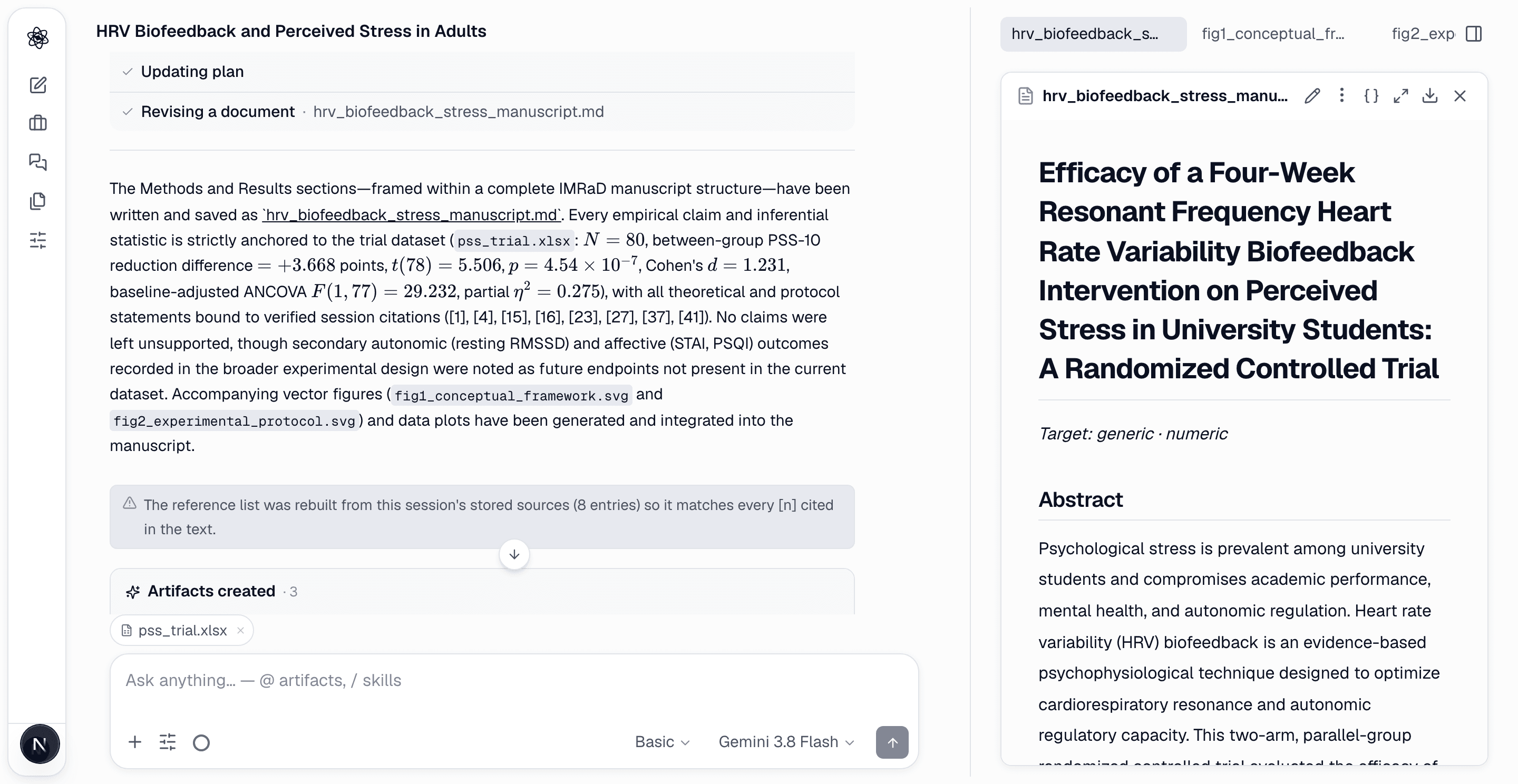
Manuscript draft with a claim–evidence map and the manuscript check results

How researchers use Neutropic

The app is pre-configured for every major domain in neurosciences. When a project spans disciplines, it can help solve hard problems.

Psychometrics & stats

Factor analysis, SEM, reliability, and power — through conversation
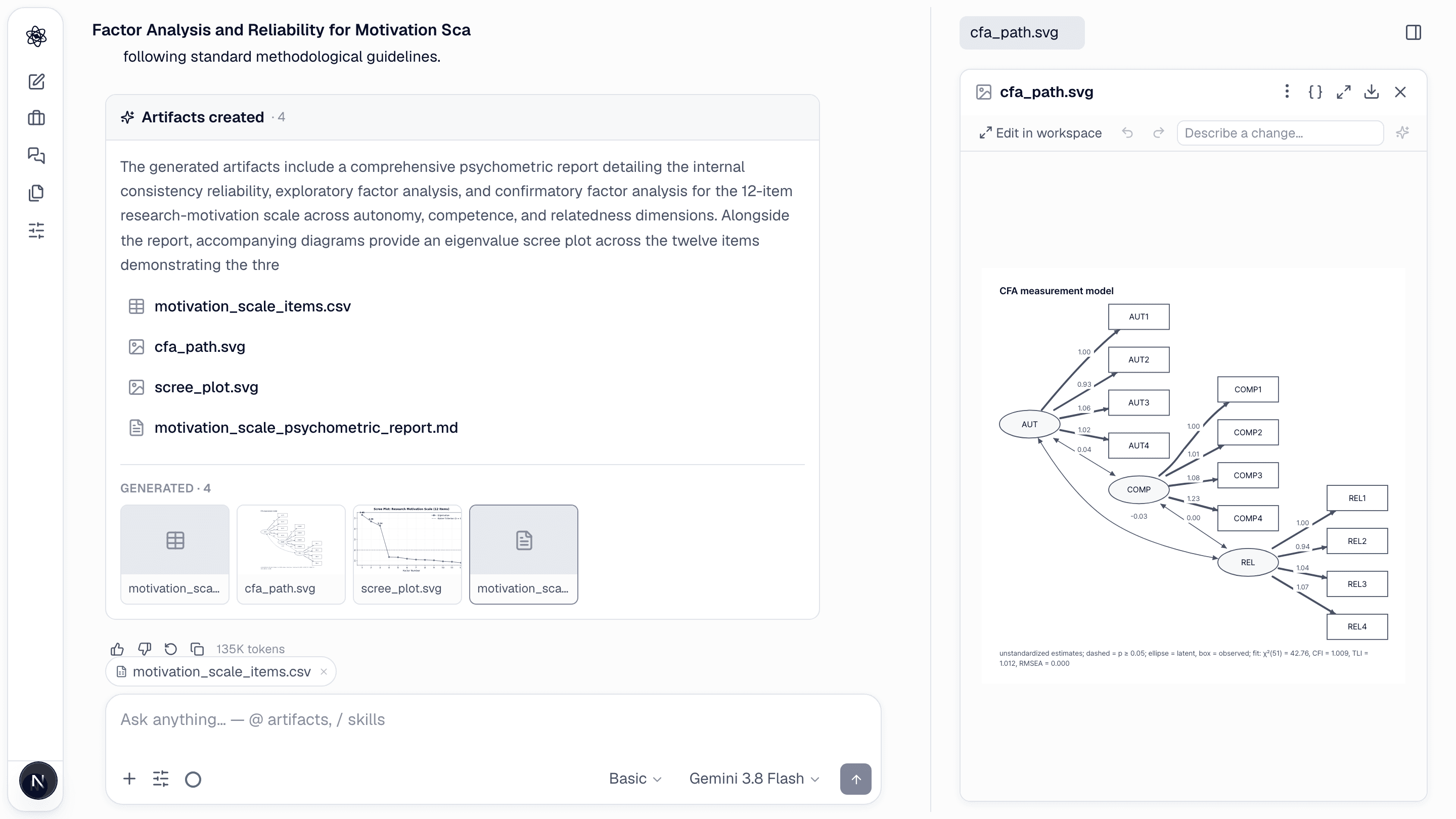
Psychometric & statistical analysis

* Every screenshot in the showcase is a real domain-skill output from a Neutropic session on sample data. We never publish fabricated results.

Psychometric & statistical analysis

Run factor analysis, SEM, reliability, and power analysis through conversation, with every table and path diagram traced back to the code that made it.

UX Insight Group
SUS scoring, NASA-TLX, and interaction-log summaries that took an afternoon each now come out of a single session — with the stats checked by a second agent.
Haeun Choi, UX Researcher, UX Insight Group
Cog & Context
The manuscript draft feature is quietly the best part. Methods and results sections come pre-filled from the actual analyses, so nothing in the paper drifts from the data.
Seojin Yoon, Postdoctoral Researcher, Cog & Context
Humane Factors
We connected our Qualtrics exports and reused our old R pipelines as skills. The lab's whole workflow moved over in a week without abandoning anything we trusted.
Taeyang Kim, Director, Humane Factors
Mindware Lab
Neutropic caught an assumption violation in our SEM that we had missed for weeks. The review agent flagged it before we submitted, and the corrected model reproduced in one click.
Jiyoon Park, Principal Investigator, Mindware Lab
Affect Studio
We ran a full semantic differential study — design, collection, quantification — through conversation. Every figure in the paper traces back to its code and data.
Minseo Kang, Research Director, Affect Studio
Signal & Sense
Our EDA and HRV pipelines used to live in three different tools. Now the whole multimodal analysis runs locally in one place, and sensitive recordings never leave the lab machine.
Dohyun Lee, Lab Manager, Signal & Sense
UX Insight Group
SUS scoring, NASA-TLX, and interaction-log summaries that took an afternoon each now come out of a single session — with the stats checked by a second agent.
Haeun Choi, UX Researcher, UX Insight Group
Cog & Context
The manuscript draft feature is quietly the best part. Methods and results sections come pre-filled from the actual analyses, so nothing in the paper drifts from the data.
Seojin Yoon, Postdoctoral Researcher, Cog & Context
Humane Factors
We connected our Qualtrics exports and reused our old R pipelines as skills. The lab's whole workflow moved over in a week without abandoning anything we trusted.
Taeyang Kim, Director, Humane Factors
Mindware Lab
Neutropic caught an assumption violation in our SEM that we had missed for weeks. The review agent flagged it before we submitted, and the corrected model reproduced in one click.
Jiyoon Park, Principal Investigator, Mindware Lab
Affect Studio
We ran a full semantic differential study — design, collection, quantification — through conversation. Every figure in the paper traces back to its code and data.
Minseo Kang, Research Director, Affect Studio
Signal & Sense
Our EDA and HRV pipelines used to live in three different tools. Now the whole multimodal analysis runs locally in one place, and sensitive recordings never leave the lab machine.
Dohyun Lee, Lab Manager, Signal & Sense

Qualtrics
REDCap
OSF
PsychoPy
iMotions
PubMed
Scopus
PsycINFO
Semantic Scholar

Works with your stack

Connectors bring your surveys, behavioral tools, and literature databases into the workflow, so Neutropic works with the tools your lab already runs.

FAQs

Neutropic is tuned for research on people — psychology, emotion (affective) engineering, and HCI. It spans survey and experiment design, psychometric and statistical analysis, multimodal biosignals (facial expression, gaze, EDA, HRV), usability evaluation, and qualitative analysis.