The most dangerous moment in a study's life is the transfer into prose. Numbers get retyped, an analysis gets rerun "one last time," and the manuscript quietly drifts from the data it claims to describe. Neutropic closes that gap by drafting the paper from the record of what actually happened. Here is the last step of the same session.
Step 1 — Ask for the sections you need
The session already holds the cited sources, the design document, the analysis and statistics reports and the figures. One message turns them into manuscript sections.
/paper-writing Write the Methods and Results sections of a manuscript from the literature, design, and analyses in this session, with every claim cited or tied to a session result.
Step 2 — Methods that write themselves — honestly
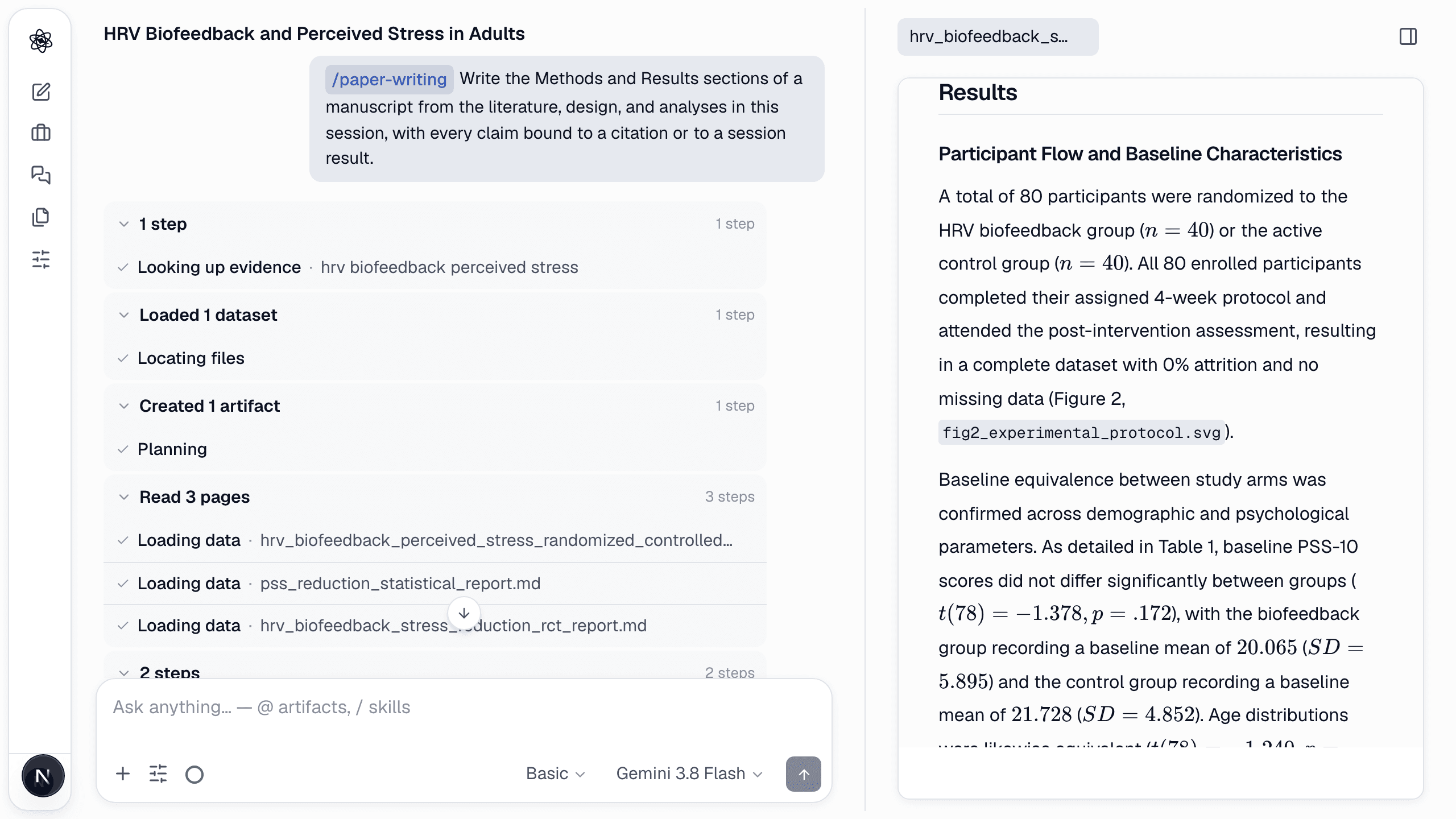
The methods section is assembled from the artifacts the study produced: the design document, the data-quality report, the analysis plan and its deviations. Sample sizes, exclusion counts and instrument details come from the record, not from memory — which means they are consistent across the abstract, the methods and the tables. You can watch it happen: the writing turn loads the design report, the statistical report and the literature report before it writes a sentence.
Step 3 — Results bound to the analyses
Every empirical sentence is bound to a session result — N = 80, t(78) = 5.51, Cohen's d = 1.23, ANCOVA F(1, 77) = 29.2 — and every background claim to a [n] citation from the literature review. The reference list is rebuilt from the stored sources so it matches exactly what the text cites.
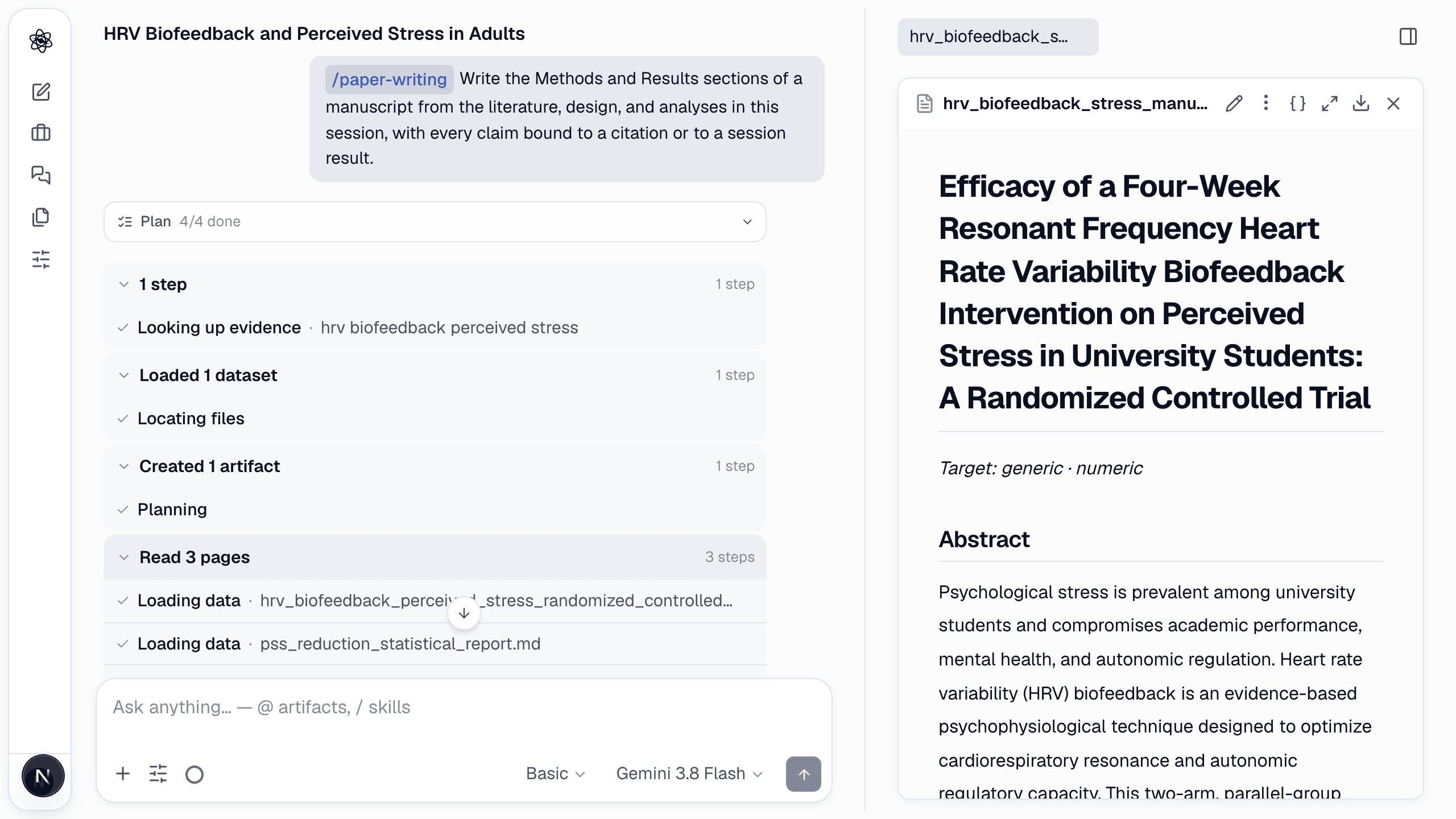
![The reference list at the end of the manuscript, rebuilt from the session's stored sources so that it matches exactly the [n] citations in the text.](/use-cases/06-references.png)
Step 4 — Unsupported claims are disclosed, not smoothed over
Anything the session cannot support is said out loud. In this run, secondary outcomes that were in the design (resting HRV, STAI, PSQI) but not in the dataset are flagged as future endpoints rather than written around. A manuscript check lists unsupported claims, missing citations and mismatched numbers for you to fix before submission.
Step 5 — Revise in place, then get it reviewed
Select a paragraph in the panel and describe the change, or ask for the Discussion next. The claim–evidence map travels with the text: edit a sentence and its sources come along, re-run an analysis and the numbers in the draft update from the same result. When the draft settles, run /review on it — an independent reviewer that re-runs the statistics and verifies the citations before a referee does.
The paper is not a separate document from the study. It is the study, rendered — and that is only true if the plumbing exists.