The manuscript is written; the numbers match the data; every claim has a citation. Now is the moment to try to break it — before a reviewer does. Neutropic's /review is an independent second opinion on any artifact in the project: a manuscript, an analysis, a study design. Here is how it went on the manuscript from this session.
Step 1 — Point the reviewer at the target
Name the artifact you want reviewed. The reviewer reads the whole document, not a summary, and it has access to the same session — the sources, the dataset and the code — so it can check rather than guess.
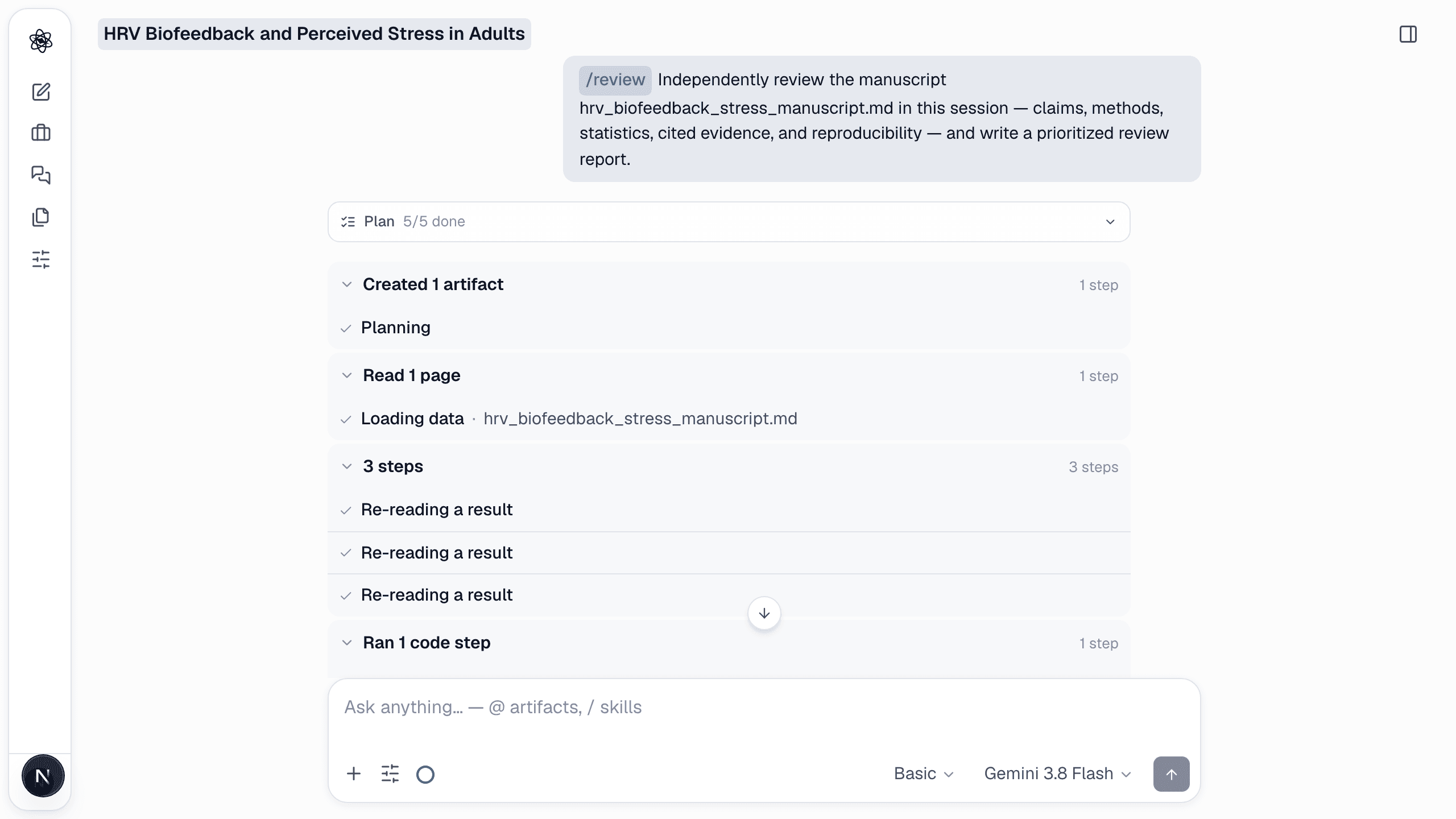
/review Independently review the manuscript hrv_biofeedback_stress_manuscript.md in this session — claims, methods, statistics, cited evidence, and reproducibility — and write a prioritized review report.
Step 2 — Watch it check, not just read
The review runs in a fixed order: parse the claims and how each is supported; review the design and measures against the standards for this study type; re-run the key statistics on the data file and compare with the reported numbers; verify the load-bearing citations — does the source exist, and does it actually say what the sentence attaches to it; and ask whether the analysis could be reproduced from what is given.
Step 3 — Read a prioritized report
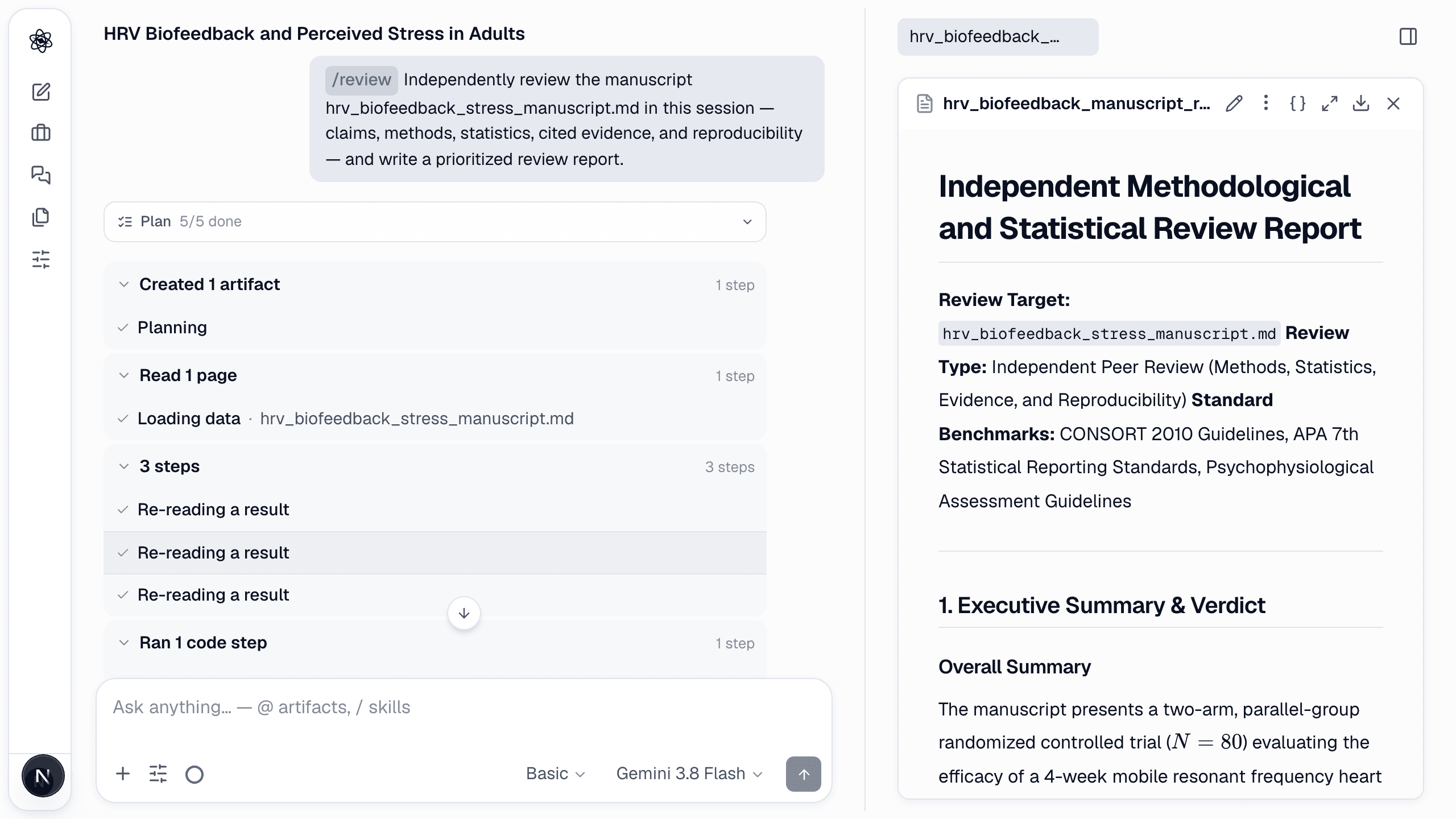
The report opens with a verdict — sound, caution, or issues — and a summary, then the claims it checked and a table of issues. Every issue has a severity (major / minor / note), a location in the manuscript, the problem, the evidence for the problem, and a concrete fix. Major issues come first; strengths are listed so the review is calibrated, not one-sided.
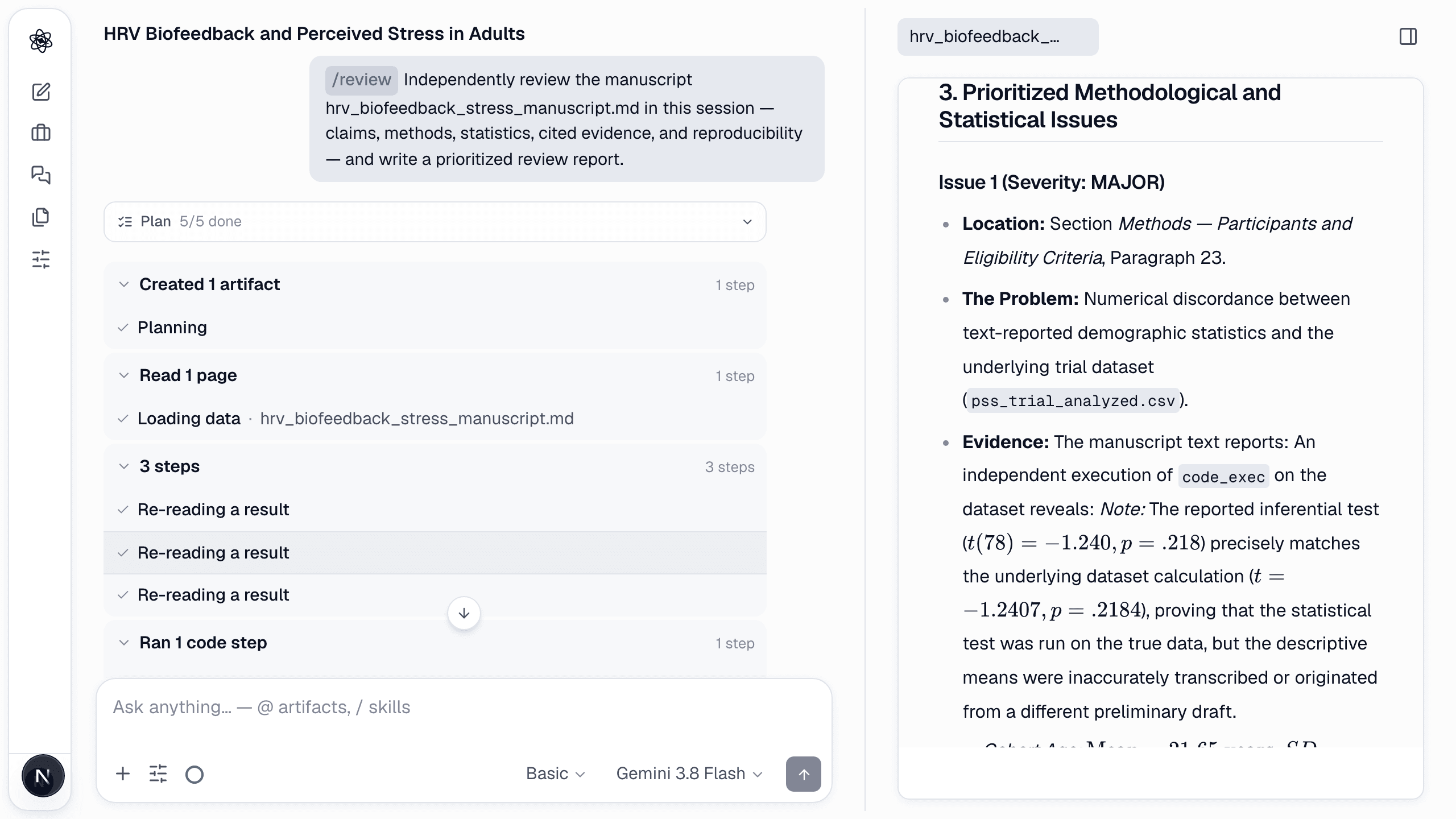
In this run it found a genuine major issue: the demographic means quoted in the Methods did not match the trial dataset, while the inferential test in the same paragraph — re-run on the data — matched exactly. That is the kind of transcription slip a human reviewer catches only by luck.
Step 4 — Fix in place
Each issue names a location, so revision is a matter of opening the manuscript in the panel, selecting the paragraph and describing the change — or re-running the analysis if the reviewer found a discrepancy. Re-run /review afterwards and the report updates against the new version.
Step 5 — Make it routine
On Deep effort the same reviewer runs automatically inside the statistics and writing steps, checking assumptions, multiple comparisons and sample size before a result reaches your report. Running it on demand is how you get a referee's reading of the whole paper while there is still time to act on it.
The best review is the one you get before submission — from something that has read every number and checked every source.