Two kinds of skill
- Workflow skills (15) run an entire task from a slash command or a plain request — clarifying questions, searches, code, review — and leave artifacts in the session. Examples:
/research,/analyze,/write. See Workflow skills. - Method skills (44) are domain-tuned analyses that run inside the built-in Python kernel — reliability, CFA, HRV, SUS scoring, topic modeling — each with the right checks, effect sizes and figures. Workflow skills compose them; you can also ask for one by name. See Method skills.
Every skill has a reference page at /docs/skills/ref/<key> listing what it produces, which methods it composes, and which workflows call it.
How a skill is chosen
- A slash command pins the workflow skill.
- Otherwise the agent picks from your request — "compare the two versions with effect sizes" selects statistics.
- A tag
[Use skills: <key>]at the start of a message forces a skill.
Method skills are chosen inside the workflow by the analysis plan: the data-analysis skill inspects the data, decides on tests, and calls the matching methods with their assumption checks.
Turn skills on and off
Customize → Skills lists every skill with a switch. Switch a method off to keep the agent from using it in this account — for example to forbid a test your field doesn't accept. Workflow skills stay on.
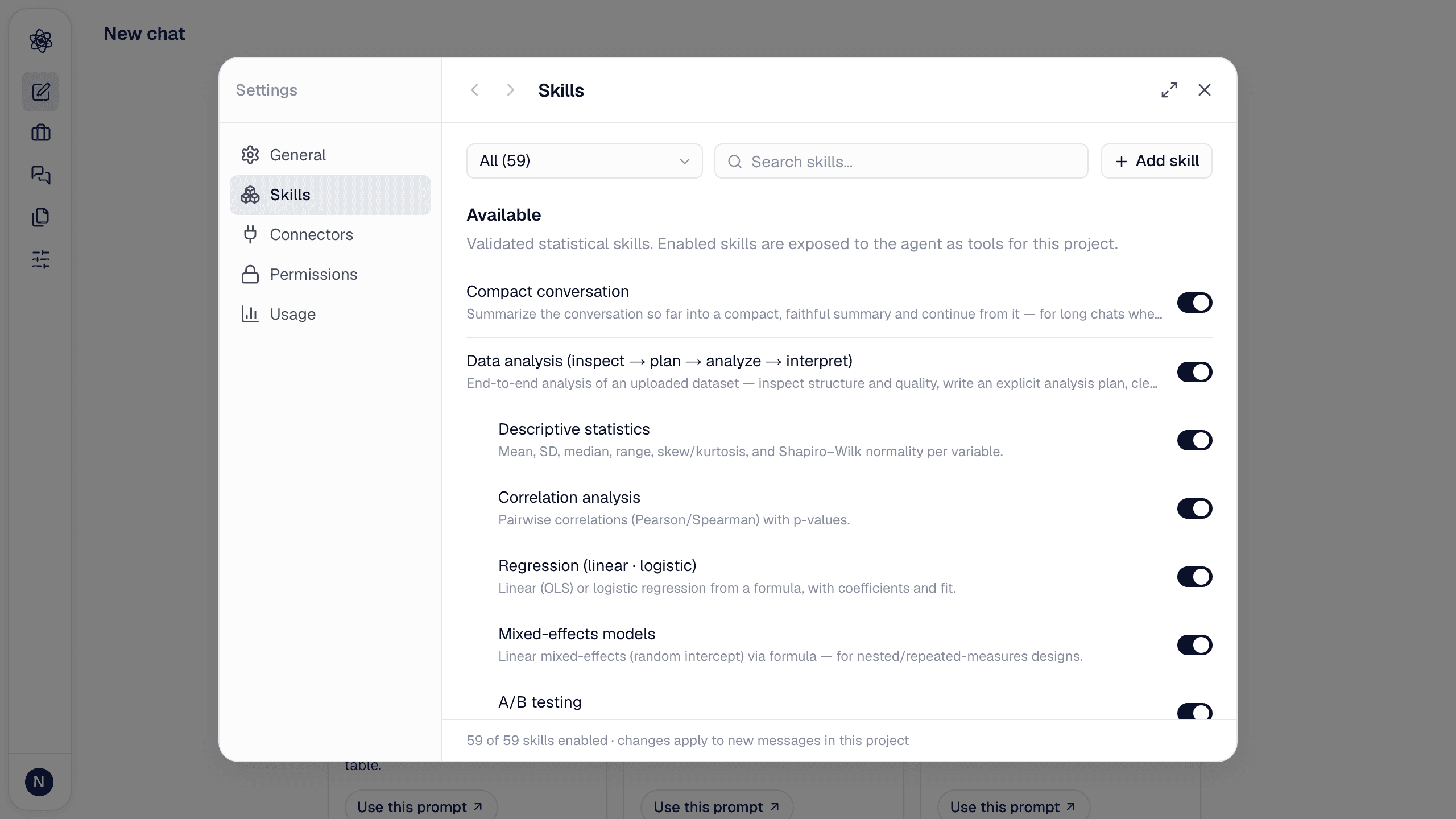
Custom skills
Save your lab's own pipeline — prompts, tools and review criteria — as a custom skill and reuse it across projects. See Custom skills.
Browse
The public skills catalog groups everything by domain with links to guides; the pages here are the reference.