/review is an umbrella for two review tracks. It reads your request and picks one:
- Report review (
/report-review) — an independent methodological check of a report, analysis or study design in your project. This guide covers this track. - Peer review (
/peer-review) — a whole manuscript, thesis or dissertation reviewed for a target journal, with five reviewers and an editorial decision. See the Peer review guide.
If you ask about a target journal, submission readiness or reviewer comments, /review runs Peer review. If you point at a report or ask for a specific check ("check the statistics in section 3"), it runs Report review. Type /report-review or /peer-review to choose the track yourself.
How to call it
text
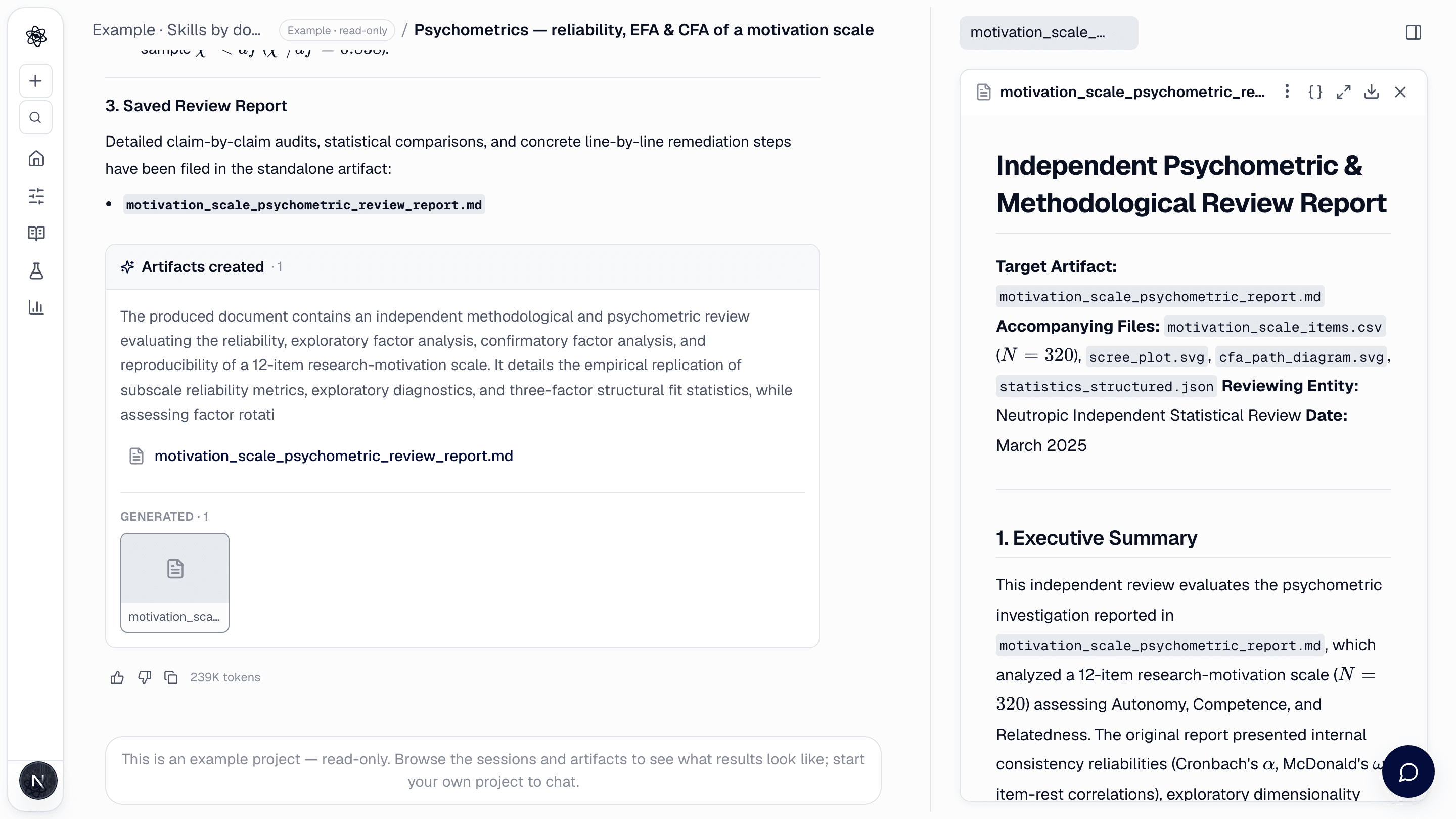
/report-review Independently review the psychometric analysis report in this chat: check the reliability, EFA and CFA methods, the statistics reported, the interpretation and reproducibility, and write a prioritized review report with concrete fixes.
Name one artifact. If the target is unclear, the reviewer takes the most recent matching artifact and says in the first line which one it reviewed.
What happens, in order
- Claim parsing — what the report claims and how each claim is supported: a citation, a statistic, an argument, or nothing.
- Method review against the standards for the study type — design fit, sampling, measurement, confounds.
- Statistical review — assumptions, test choice, multiple comparisons, effect sizes and confidence intervals. When the data file is in the project, the key numbers are re-computed and compared with what the report says.
- Evidence check — does each load-bearing source exist, and does it actually say what the sentence attaches to it? Missing contradictory literature counts as an issue.
- Reproducibility — can the analysis be reproduced from the code, data and parameters given?
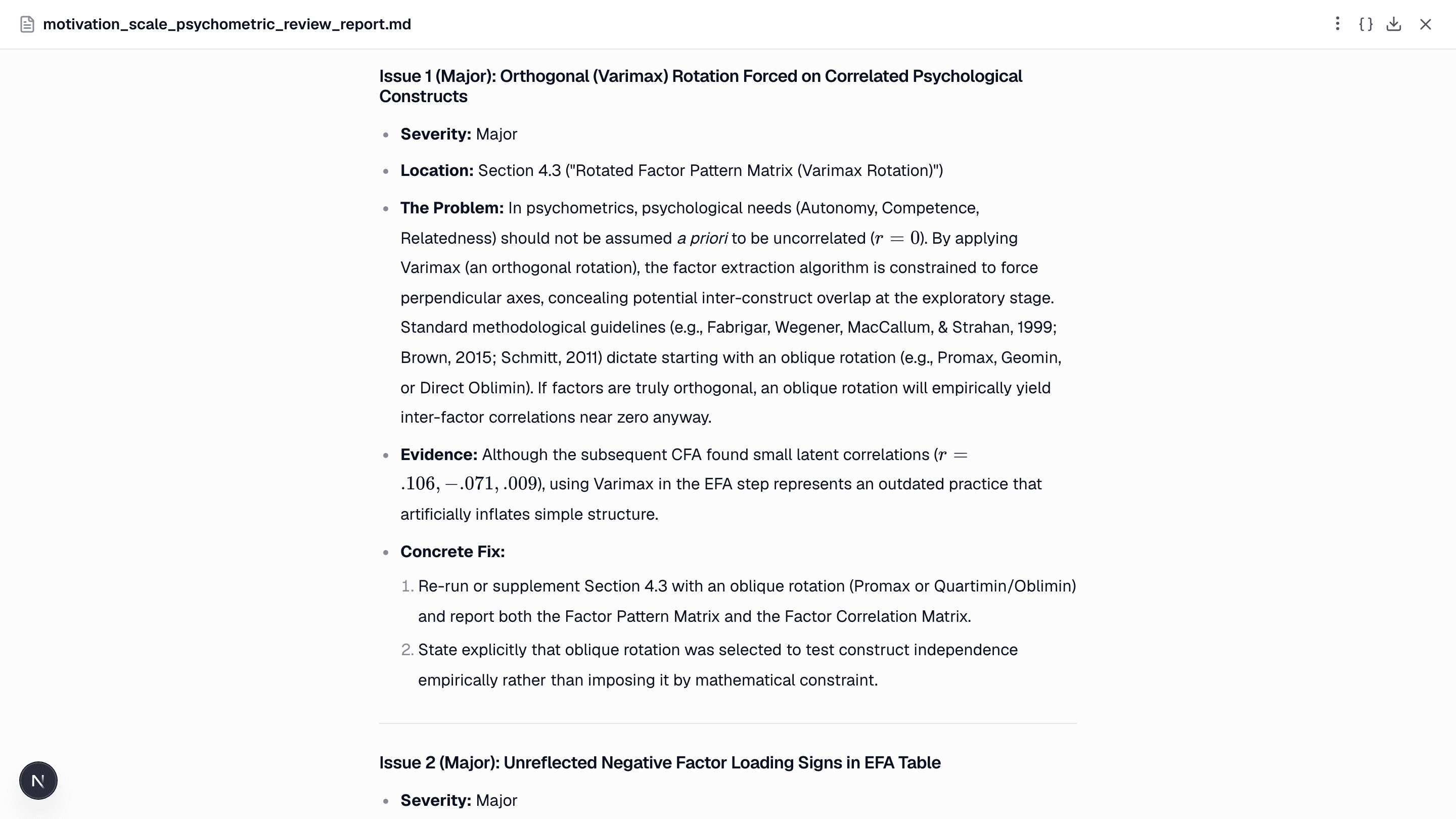
- A prioritized report — summary, verdict (sound / caution / issues), claims checked, issues by severity (major / minor / note) each with location · problem · evidence · fix, reproducibility, and strengths.
What you get
- The review report (Markdown) and a structured ReviewReport (JSON).
- Sentence-level [n] citations. The sources are the reviewed document, the papers read in the session and the re-analysis steps of this turn, listed in a References section. Click a number to see the exact passage or step.
Tips
- Run it before you share results with an advisor or co-author — it catches numbers the data does not produce.
- Revise, then run it again. The new report reviews the new version.
- A full manuscript heading to a journal belongs in Peer review. Report review is for the pieces: an analysis, a design, a single section.
- Even without /review, a lighter reviewer checks analysis, statistics and writing turns before the answer is shown. /report-review is the full, independent pass.