Physiological data punishes silent assumptions. A filter setting, an artifact-rejection threshold, or a misaligned event marker can quietly reshape every downstream statistic. Neutropic's signal pipelines are built to keep those decisions loud. The screenshots below are from one real session on a sample face video (20 s, 30 fps).
Step 1 — From a recording to explicit steps
Import EDA, ECG, respiration, or eye-tracking recordings — or a plain video — and the agent proposes a preprocessing pipeline — filtering, artifact handling, epoching around your event markers — as explicit, editable steps. Nothing is applied silently; every choice is stated and revisable.
/analyze Analyze the uploaded face video: extract facial action units and expression over time and estimate heart rate from remote PPG (rPPG). Plot the AU time series and the rPPG signal with the estimated BPM, and summarize the results.
Step 2 — Facial action units over time
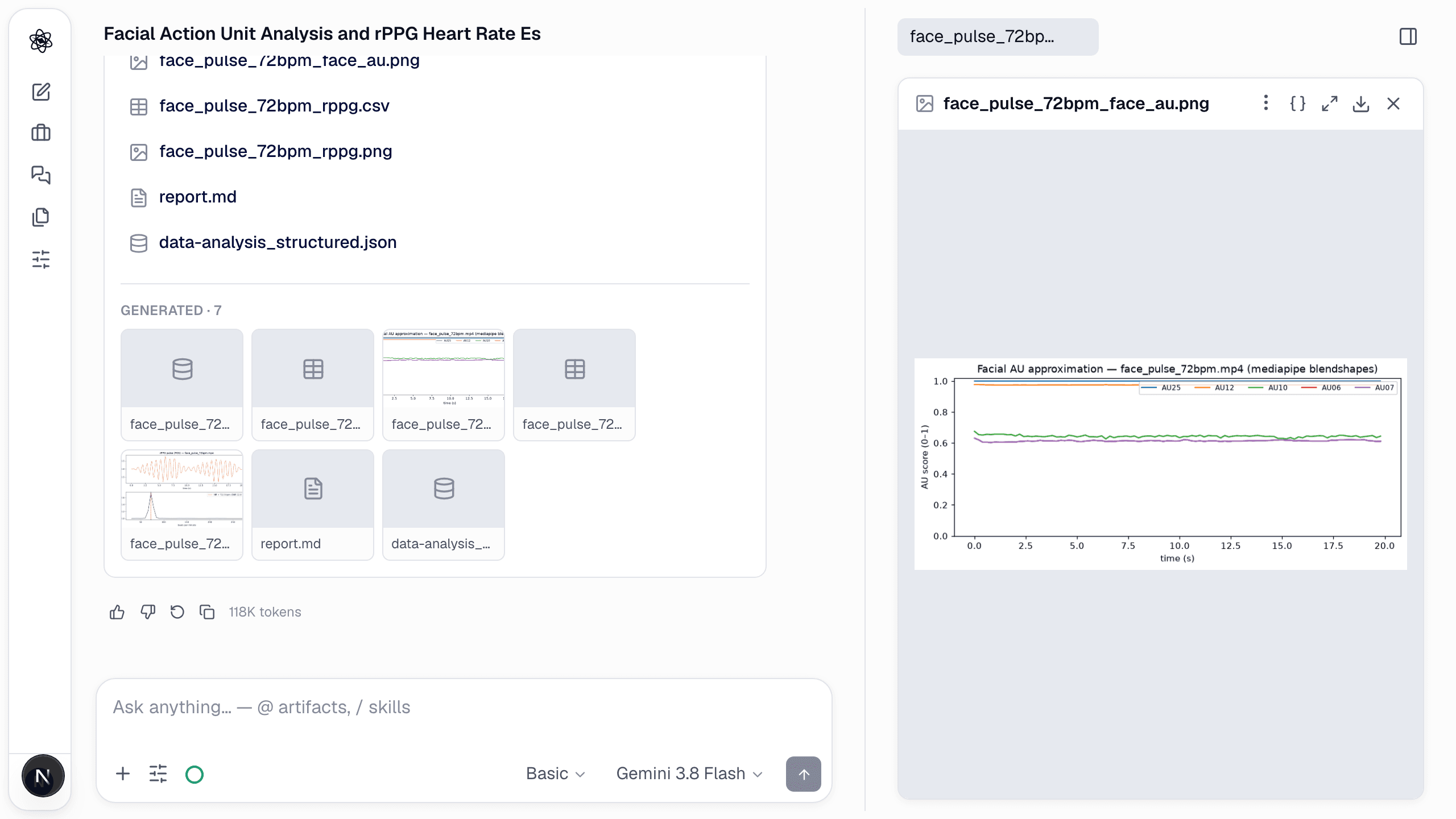
The face landmarker runs frame by frame and the action-unit scores (AU06, AU07, AU10, AU12, AU25 here) are plotted against time — with the CSV behind the plot saved next to it.
Step 3 — Heart rate without a sensor
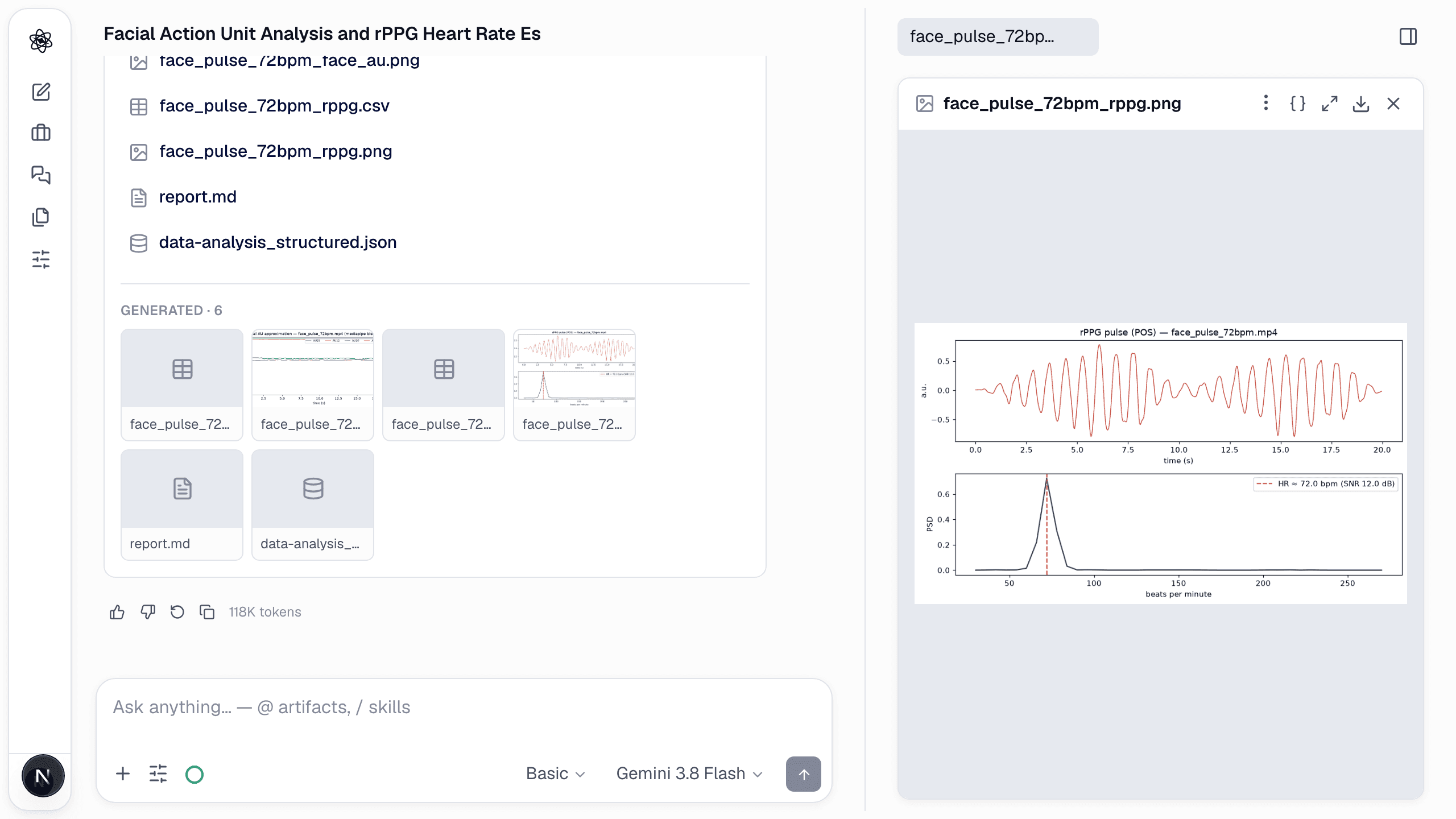
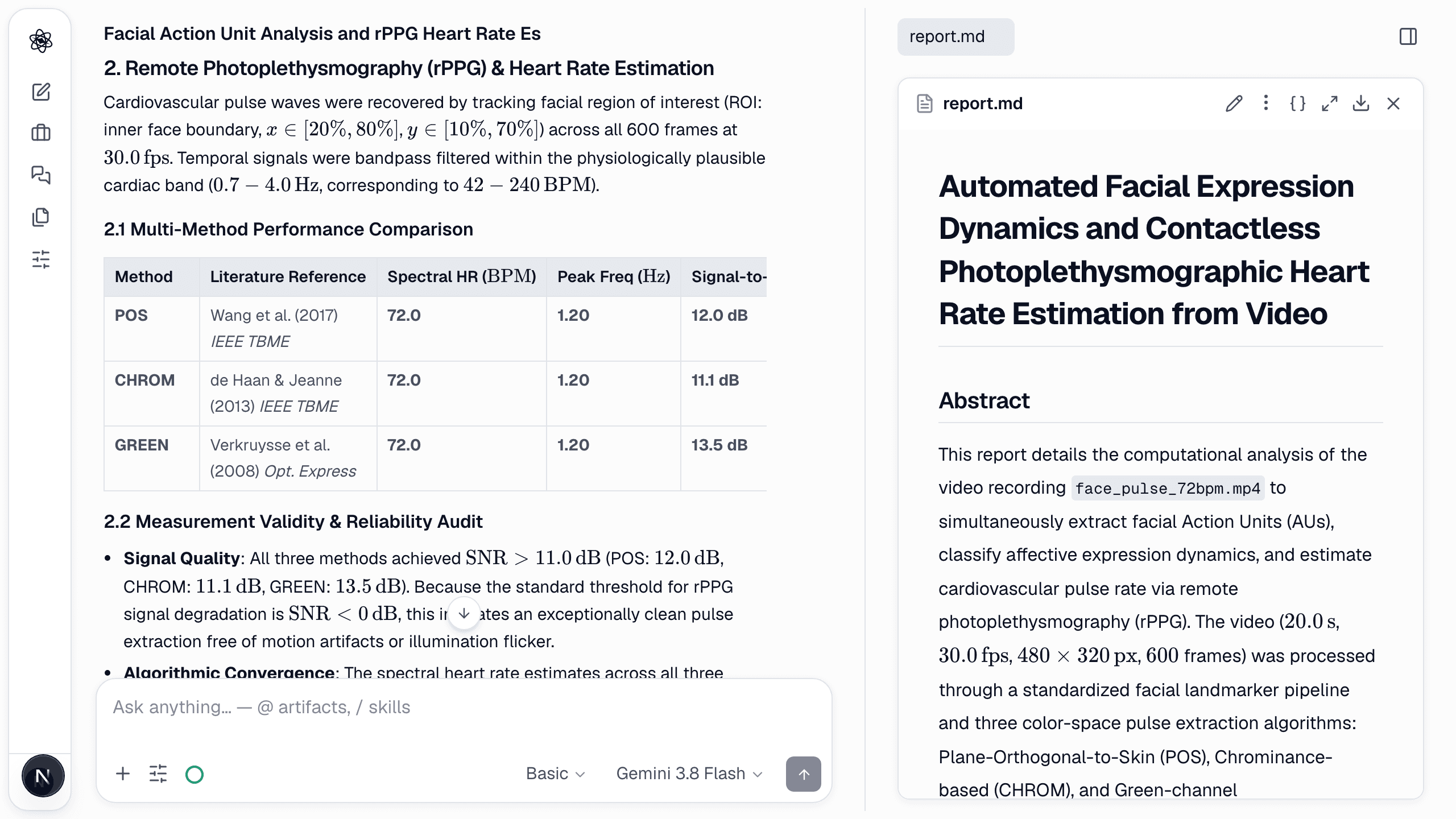
Three colour-space rPPG algorithms (POS, CHROM, GREEN) are run and compared; the pulse trace and its spectrum give 72.0 bpm — matching the recording's ground truth — with the SNR reported so you know how much to trust it.
Step 4 — A report that names its algorithms
The report states the pipeline — landmarker, the three pulse-extraction algorithms, the window — and the numbers, so a reviewer can follow the path from video to heart rate.
Multimodal alignment
Recordings from different devices rarely agree about time. Neutropic aligns signals to a shared timeline using your sync markers and shows you the alignment before analysis, so a 200 ms offset never becomes a spurious finding.
Features and statistics in one place
- SCR counts and amplitudes, tonic and phasic EDA decomposition.
- Time- and frequency-domain HRV measures with the recording-length caveats attached.
- Facial action-unit intensities and gaze metrics per condition and epoch.
- EEG band power, ERP, ERD/ERS and SSVEP pipelines with the reference scheme stated.
Feature tables flow straight into mixed models or condition comparisons, and the review agent checks the statistical assumptions like it does for any analysis.
Honest about uncertainty
Where the field disagrees — HRV metrics on short recordings, EDA decomposition methods — Neutropic says so and cites the methodological literature, instead of presenting one lab's convention as ground truth.