Hi, this is the Neutropic team!
Picture the night before a lab report is due. The measurements are done and the table is filled in. All that is left is to calculate the density and attach an uncertainty. And that "all that is left" step is exactly where marks disappear. 🥲
Two things go wrong again and again. The first is units: from mm³ to m³ is a factor of a billion, and one wrong exponent gives a nonsense density. The second is how uncertainties combine. Relative uncertainties of independent measurements are not simply added; they combine in quadrature. And a quantity that enters squared, like the diameter in a cylinder's volume, counts twice.
In this post we follow Sam, a third-year materials engineering student, as they finish a density report for a cylindrical sample. Sam is fictional, but every screen below comes from a real chat in Neutropic.
Sam wrote the measurements and the questions in one paragraph
Sam didn't write out any formulas. They copied the measurements with their ± values and added the three things the report needed.
I measured a cylindrical sample: diameter 12.0 ± 0.1 mm, length 50.0 ± 0.2 mm, mass 15.20 ± 0.05 g. Calculate its density in kg/m³ with the uncertainty, show the calculation, and tell me which measurement contributes most to the uncertainty.
Three things make this a good request. Every measurement has a unit and a ±. The target unit is fixed. And it asks for more than a number: the working and the biggest contributor. That last question turns the answer into advice on what to measure more carefully next time.
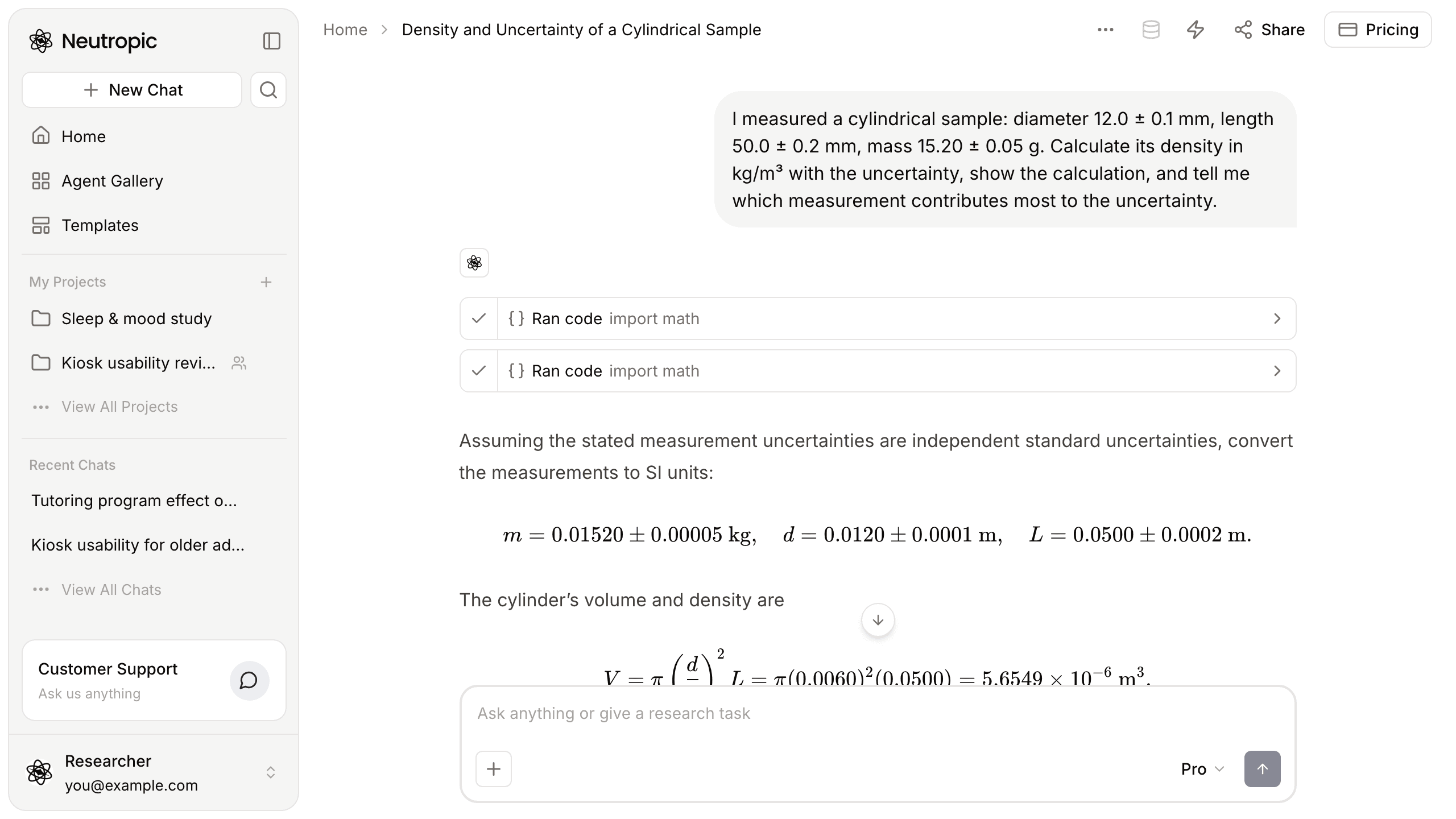
It calculated in code, not in its head
Two Ran code steps appeared. The density and its uncertainty were computed in code rather than written from mental arithmetic. After a first draft, Neutropic said it would verify the uncertainty components and their variance shares directly from the inputs, ran the code again, and rewrote the answer consistently. Click either step to see the calculation.
The density came out at (2688 ± 47) kg/m³
The answer stated its assumption first: the ± values are treated as independent standard uncertainties. Then it worked through the steps.
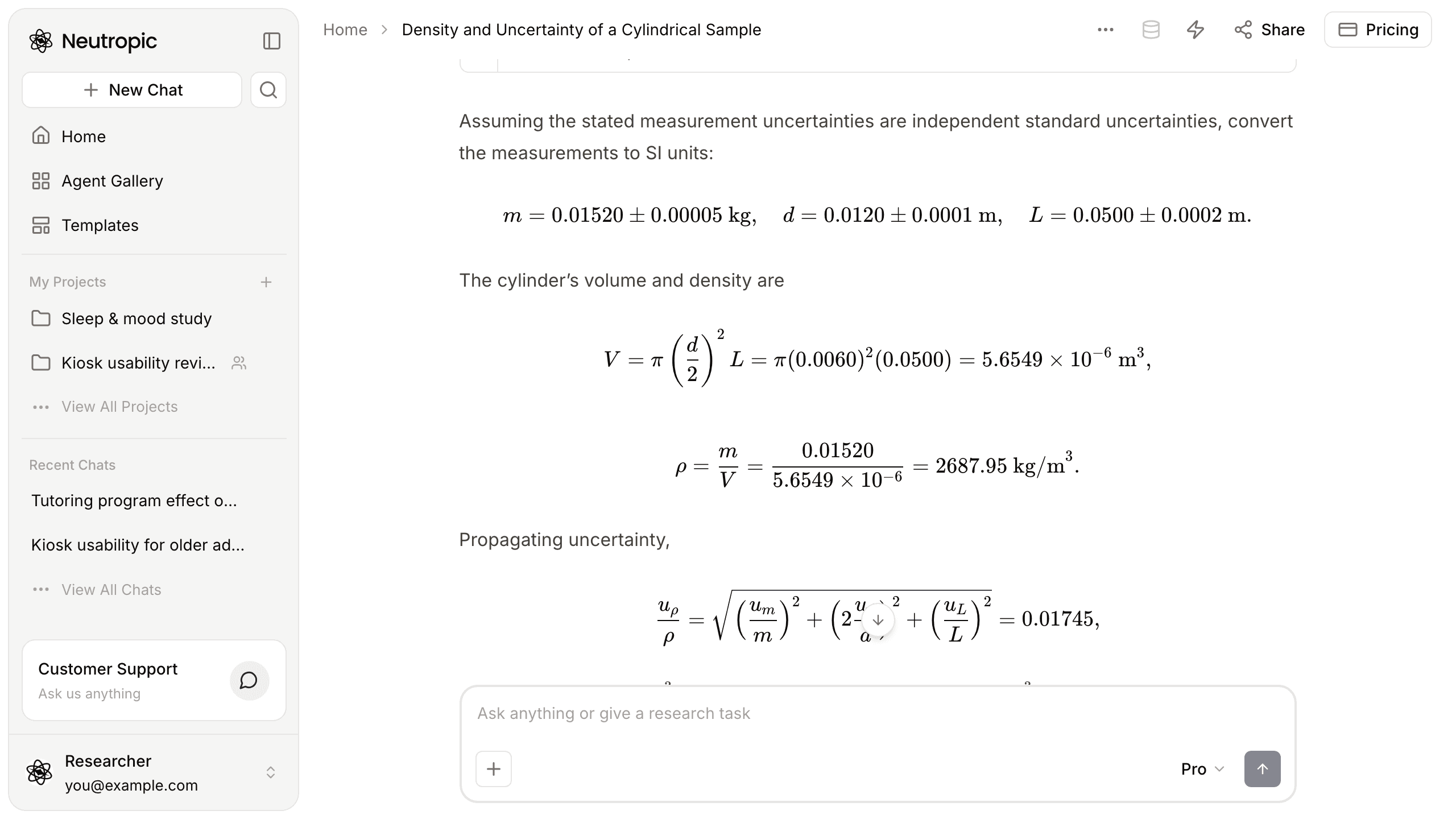
- Convert to SI: m = 0.01520 ± 0.00005 kg, d = 0.0120 ± 0.0001 m, L = 0.0500 ± 0.0002 m.
- Volume: V = π(d/2)²L = 5.6549 × 10⁻⁶ m³. Density: ρ = m/V = 2687.95 kg/m³.
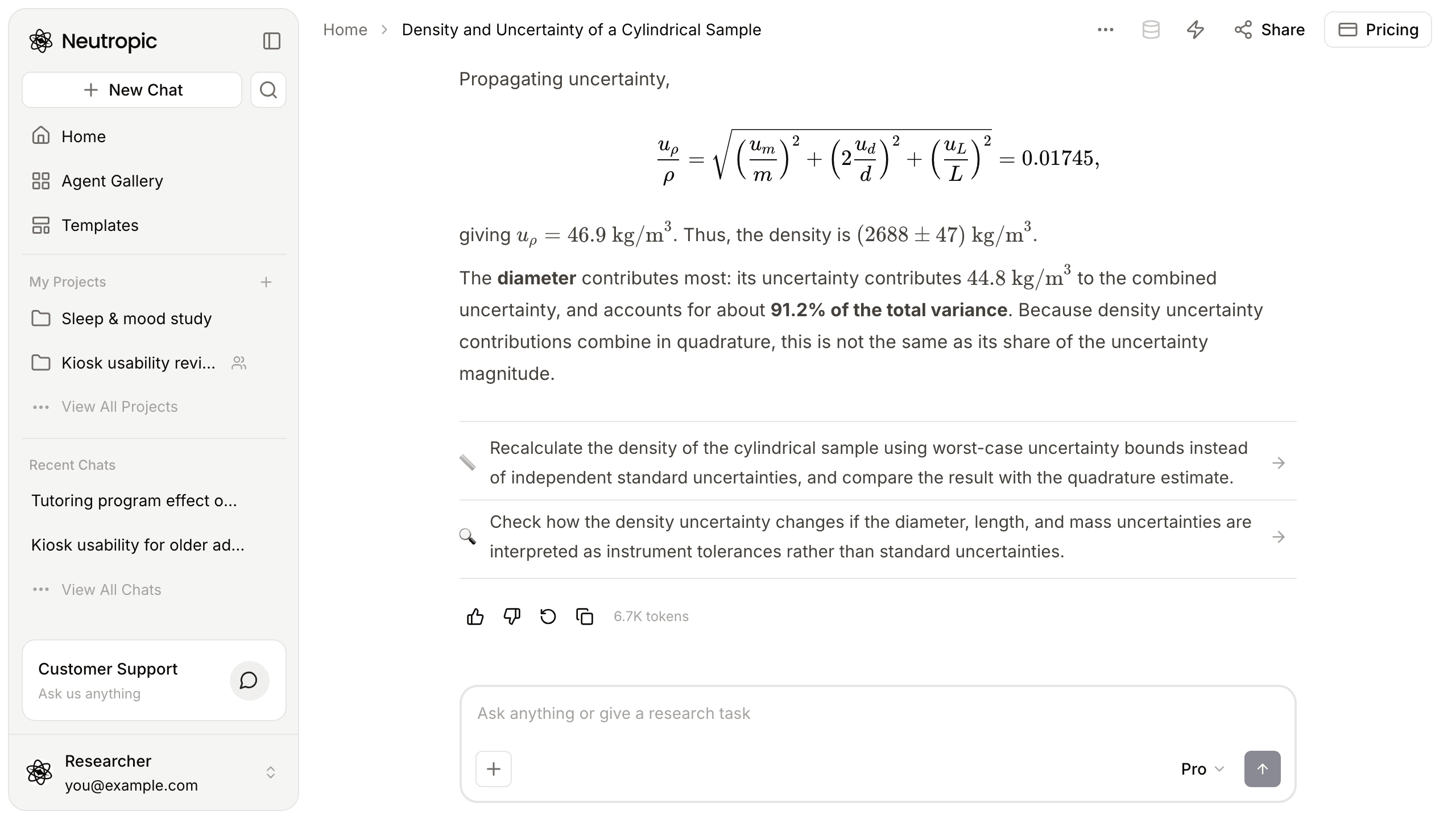
- Propagate: the relative uncertainty combines mass, twice the relative diameter uncertainty, and length in quadrature, giving 0.01745 — about 1.75%.
- So u = 46.9 kg/m³, and the density is (2688 ± 47) kg/m³.
We redid the calculation independently from the same inputs and got the same volume, density, uncertainty and shares. 😎
The diameter accounts for 91% of the variance
The answer to Sam's last question was clear. The diameter contributes most: its uncertainty adds 44.8 kg/m³ to the combined uncertainty and accounts for about 91.2% of the total variance. Its relative uncertainty looks small, around 0.83%, but the volume depends on the diameter squared, so it enters the density twice.
This is where Sam nearly made a mistake. "91% of the variance" is easy to misread as "91% of the 47 kg/m³". The answer heads that off: because contributions combine in quadrature, a share of the variance is not the same as a share of the uncertainty's size. The diameter's part is 44.8 of the 46.9 kg/m³, which is about 96% of the magnitude but 91% of the variance.
There is a second caveat Sam has to carry into the report: the whole result rests on reading each ± as an independent standard uncertainty. If a ± is really an instrument tolerance or a worst-case bound, it must be converted first, and the answer changes.
It suggested what to do next
Under the answer were two follow-ups that test exactly that assumption:
- Recalculate the density using worst-case uncertainty bounds instead of independent standard uncertainties, and compare the result with the quadrature estimate
- Check how the density uncertainty changes if the diameter, length and mass uncertainties are interpreted as instrument tolerances rather than standard uncertainties
Click one and the conversation continues in the same chat. If Sam's ± values came straight off the caliper's spec sheet, the second one is worth a click.
Three numbers became one defensible result
| At the start | Now | |
|---|---|---|
| Units | A mix of mm and g | Everything in SI |
| Result | No density yet | (2688 ± 47) kg/m³, relative 1.75% |
| Working | Hunting for the formula | Volume, density and propagation step by step |
| Biggest contributor | Unknown | Diameter: 91.2% of the variance |
| Assumptions | Never considered | Independent standard uncertainties, stated up front |
To be honest about the limits: the result holds only if each ± is a standard uncertainty and the three measurements are independent. Correlated readings, such as two dimensions taken with the same miscalibrated instrument, do not combine in quadrature. And the uncertainty decides how many digits the result deserves.
This walkthrough used Pro. Lite (the free plan) gives the formula and a quick result; Expert also builds an uncertainty budget and discusses correlated inputs.
Uncertainties don't add — they combine in quadrature, and anything squared counts twice.
For this week's lab report, write down your measurements with their ± values and ask — just like Sam. Start with Neutropic for free