Hi, this is the Neutropic team!
"Would a mindfulness app reduce test anxiety?" Once an idea like that takes hold, you want to start designing the experiment right away. But a supervisor's first question is almost always the same: "Have you looked at the prior studies?" 🥲
That turns out to be hard. Every search returns hundreds of hits, and you have to open abstract after abstract to tell whether a study is about an app or an in-person course, about students or about employees. Even after you shortlist a few, "So does it work or not?" is surprisingly difficult to answer.
In this post we follow Alex, an educational psychology master's student, reviewing prior studies before designing a thesis experiment. Alex is fictional, but every screen below comes from a real run in Neutropic.
Alex asked for four things in one paragraph
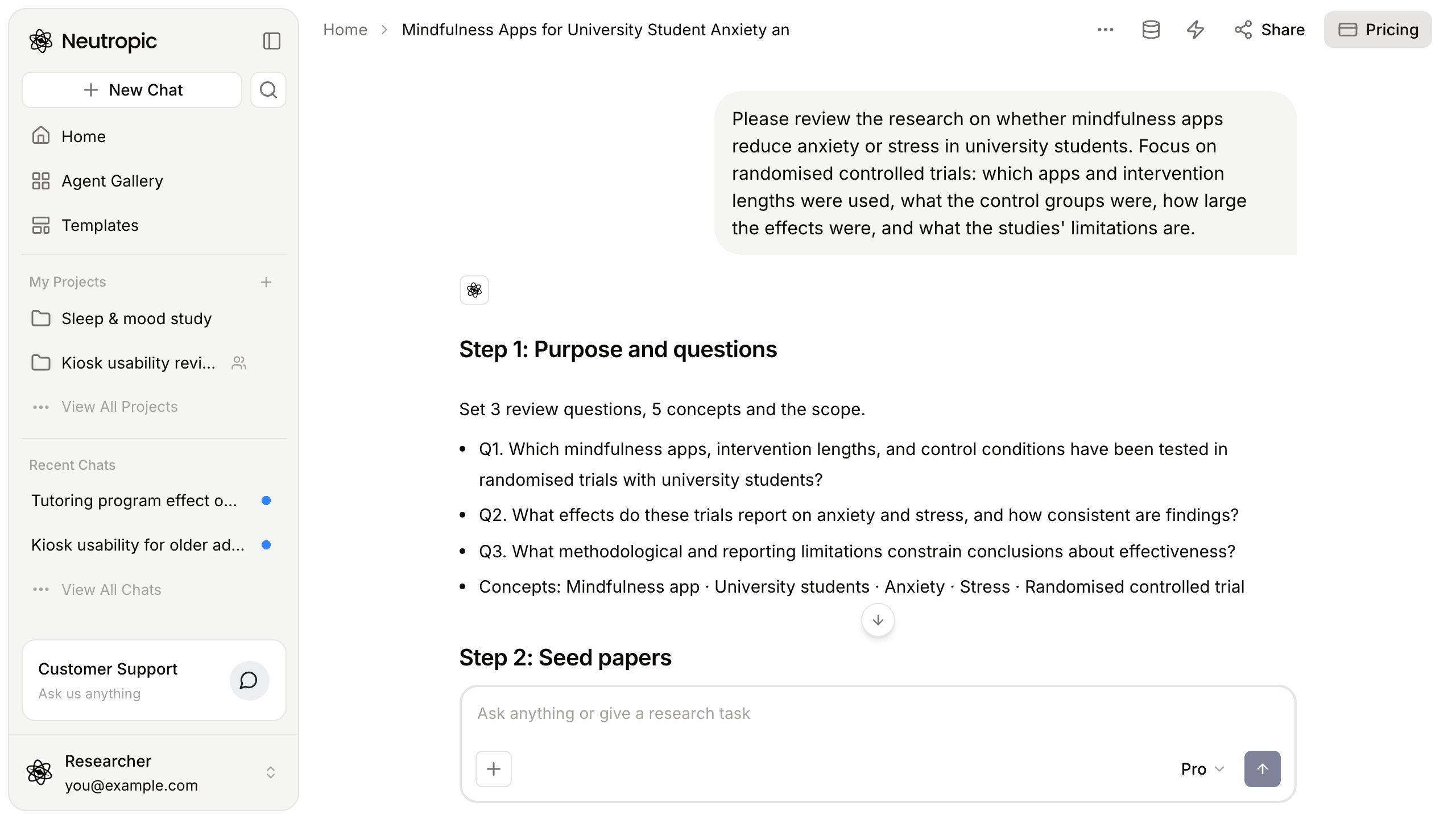
Alex opened the Narrative Review agent from the Agent Gallery, chose Pro and sent this, with no files attached:
Please review the research on whether mindfulness apps reduce anxiety or stress in university students. Focus on randomised controlled trials: which apps and intervention lengths were used, what the control groups were, how large the effects were, and what the studies' limitations are.
Two things make this a good request. It narrows the scope (university students, mindfulness apps, anxiety or stress, randomised trials), and it names the four pieces of information to extract (apps and lengths, controls, effect sizes, limitations). Those are exactly the things Alex will need later when designing a study.
The agent split the question into three and gathered papers in nine steps
The run went through nine steps in about three minutes. Step 1, Purpose and questions, turned the request into 3 review questions: which apps, lengths and controls have been tested; what effects the trials report and how consistent they are; and which limitations constrain the conclusions. Five concepts were fixed: mindfulness app, university students, anxiety, stress and randomised controlled trial.
Steps 2 and 3 set a starting point with 4 queries and then collected 200 papers from multiple databases, 66 of them through citation tracking, following the references and citing papers of key studies. Step 4, Saturation, was honest: it stopped at this level's limit of one tracking round, before reaching saturation.
It kept 15 of 200 papers and recorded a reason for every exclusion
Step 5, Selection and record, selected 15 of the 200 papers. The other 185 each got a reason: population or context out of scope (128), off topic (46), and highly relevant but beyond this review's scale (11). Every decision stays in the screening table, so when Alex wonders "Why was this one dropped?", the answer is there.
Steps 6 and 7 grouped the selected papers by concept and recorded evidence levels: 13 randomised experiments, 1 review and 1 quasi-experiment. Each review question was rated Tentatively supported (not established), and the reason was spelled out: fewer than half of the evidence papers were read in full text, so the rating cannot go higher.
Every conclusion came with its evidence strength
The trials were all over the place. Brightmind was compared with a math-game control for four weeks, Calm with a waitlist for eight weeks, StudiCare's five weekly web modules with a waitlist (assessed at six weeks), and a mindfulness app with psychoeducational online content for four weeks. Other comparators included usual routine, mental-health messages, in-person training and an electronic diary.
The findings were mixed. StudiCare reported improvements in anxiety and stress versus waitlist, a trial in healthcare students reported lower trait anxiety versus control, and the full-text excerpt of the Calm trial reported a greater change in perceived stress than waitlist. On the other hand, a trial in college athletes found no significant differences in anxiety, and a trial on weight and stress found no significant outcome differences. The report adds that absolute scores and confidence intervals are generally not reported.
Alex nearly counted every trial as evidence about students using apps
"Small stress reductions in a mindfulness-app trial at a university, that's my population!" Alex was about to add it to the list of supporting studies. But the report describes it as a mixed university staff and student trial. Likewise, StudiCare is a web-based program, not an app. Both are useful, but not as direct evidence for undergraduates using an app.
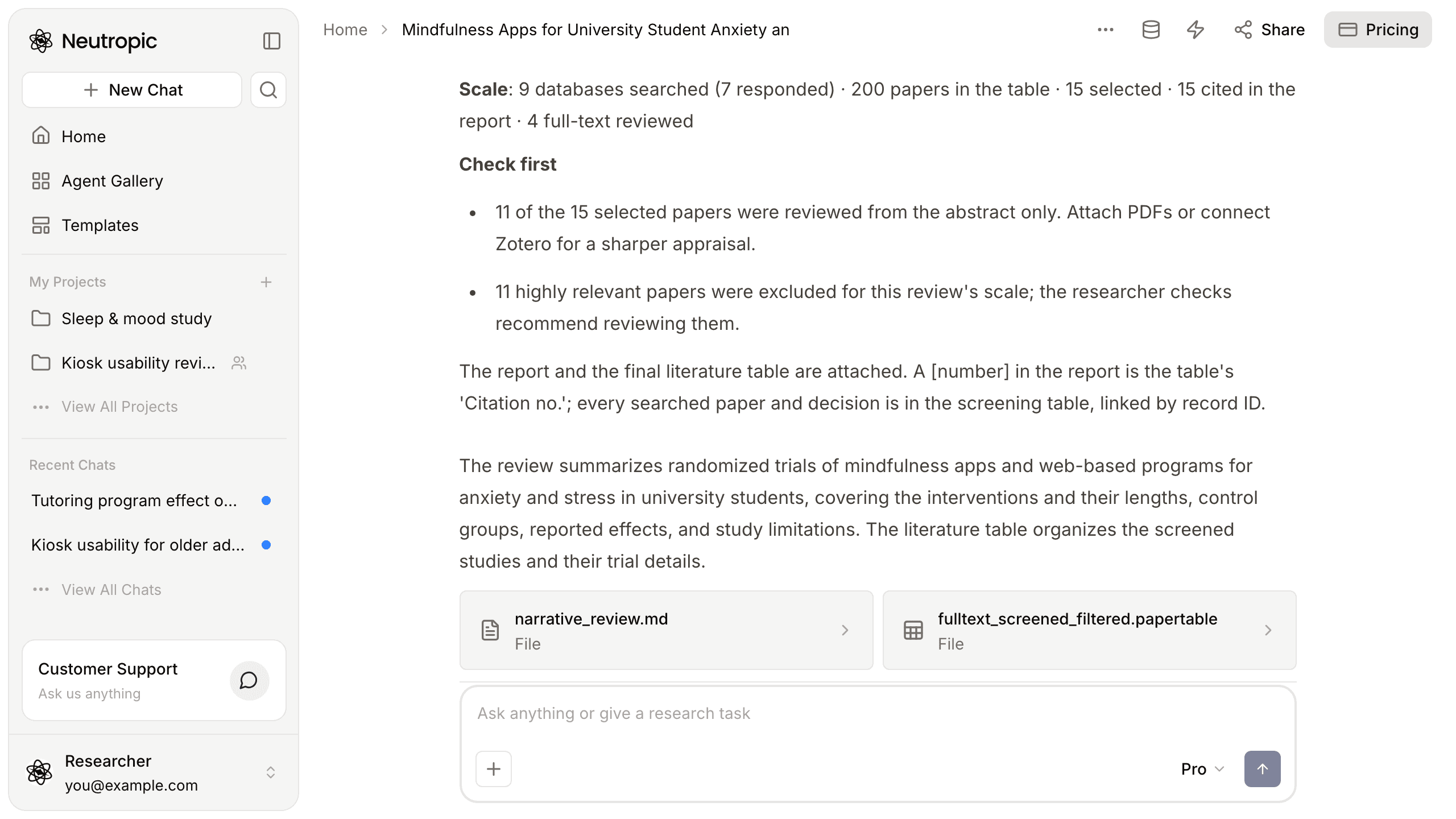
Then there is the scale line: 15 selected, 4 reviewed in full text, 11 from the abstract only. That is why every conclusion carries Tentatively supported and why the report keeps saying that effect estimates are not interchangeable across studies. If Alex needs an effect size to plan a sample, none of these numbers can simply be copied over.
A report and a literature table came out together
Step 9 wrote the report and ran its checks; two checks did not pass, and the report lists them under researcher checks. There are two outputs: the review report (narrative_review.md) and a final literature table of the 15 cited papers, sorted by citation number. A [number] in the report matches the table's citation number, so each claim leads straight to its paper.
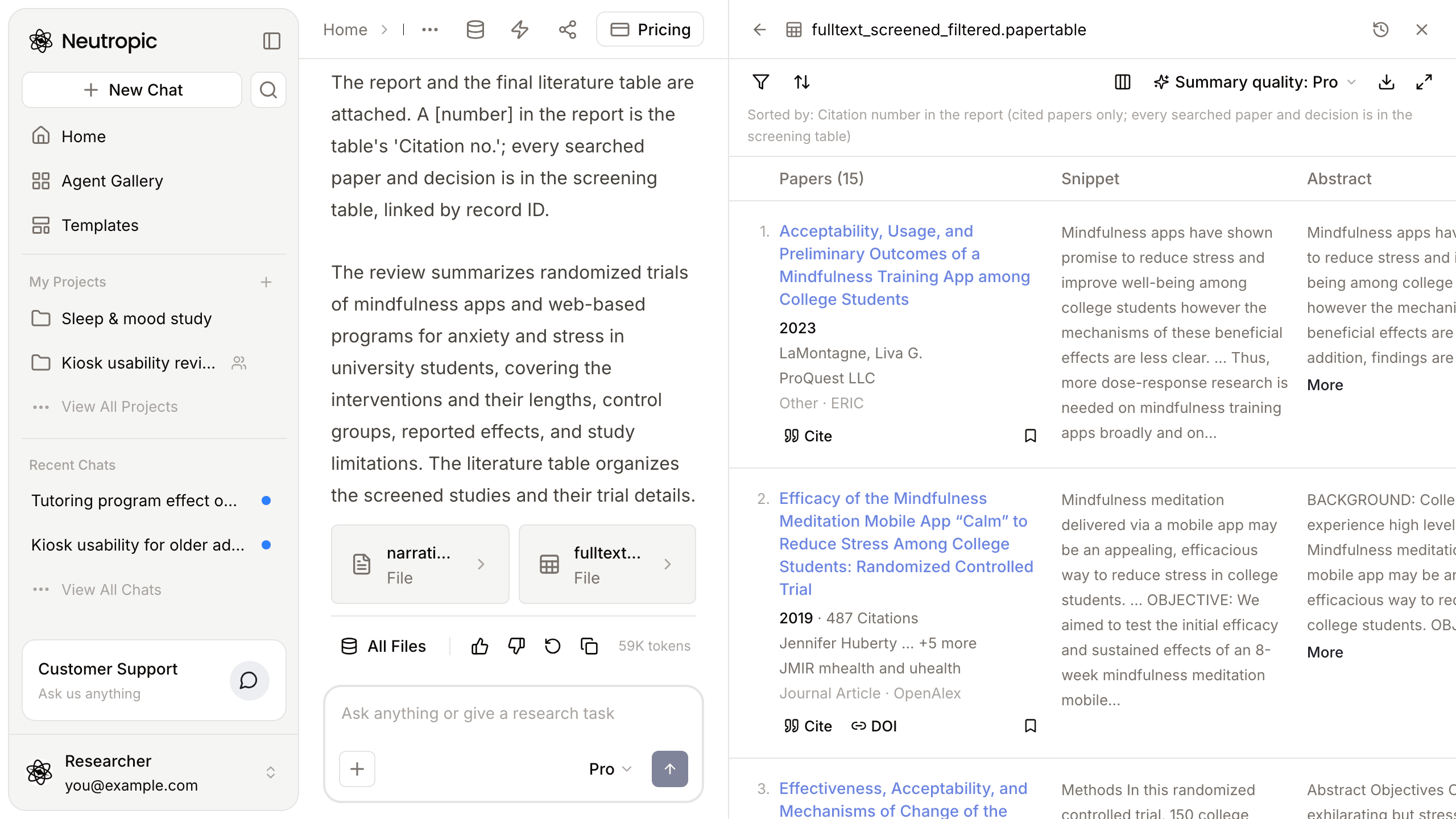
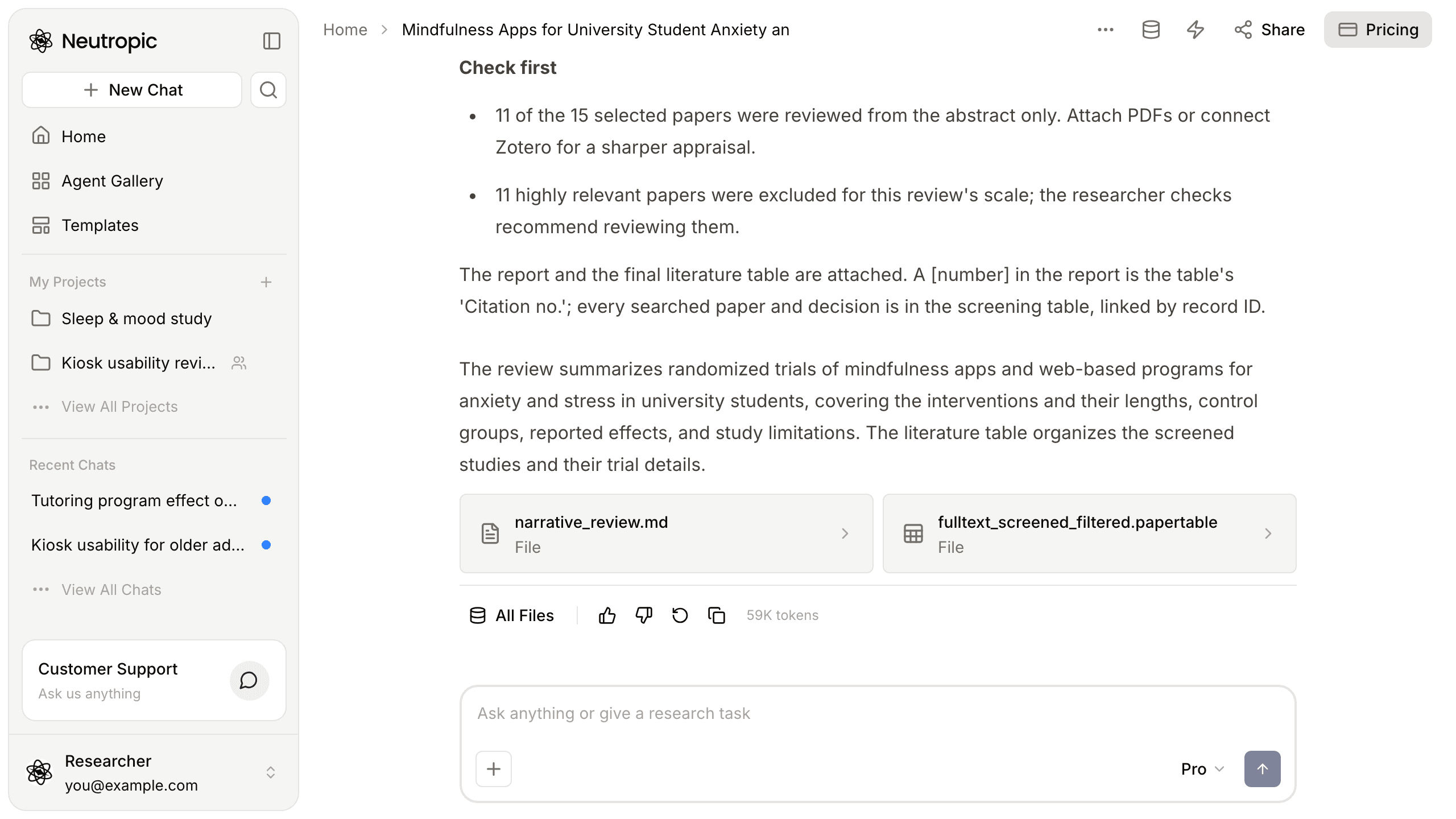
The answer also lists two things to check first: 11 of the 15 selected papers were reviewed from the abstract only, so attaching PDFs or connecting Zotero would sharpen the appraisal; and 11 highly relevant papers were left out for scale and are worth a look.
A vague search became a map of the evidence
| At the start | Now | |
|---|---|---|
| Question | "Would an app reduce anxiety?" | 3 review questions, 5 concepts |
| Papers | No idea where to start | 200 collected, 15 selected, reasons for 185 exclusions |
| Conclusions | "I heard it works" | Conclusions with evidence strength, all tentatively supported |
| Effect sizes | No idea | Which trials report what, and which report nothing usable |
| Next | Overwhelmed | Read 11 abstract-only papers in full, check 11 excluded candidates |
To be honest about the limits: 11 of the 15 papers were reviewed from the abstract only, citation tracking stopped after one round without reaching saturation, and 7 of the 9 databases searched responded. So treat this report less as a verdict and more as a map of what to read in full first. Still, starting from 15 papers with a recorded reason for every inclusion and exclusion is very different from staring at hundreds of search results.
This walkthrough used Pro, which works with up to 200 papers in the table, up to 15 selected papers, up to 5 full texts and one round of citation tracking. Lite (the free plan) gives a quick pass with up to 100 papers, 8 selected and 2 full texts. Expert raises this to up to 400 papers, 25 selected, 10 full texts and two tracking rounds, with one more round of manuscript quality checks.
One paragraph can get you a literature table with the strength of the evidence attached. Just check what was read in full before you copy any number.
Alex then moved on to designing the experiment; that story continues in the research design post. This week, write down your scope and what you want to know, just like Alex. Start with Neutropic for free